Hirayama Ikuo & the Silk Road
Hirayama Ikuo & the Silk Road
About Hirayama Ikuo
Ikuo Hirayama: Childhood
- 1930 (Showa 5)
-
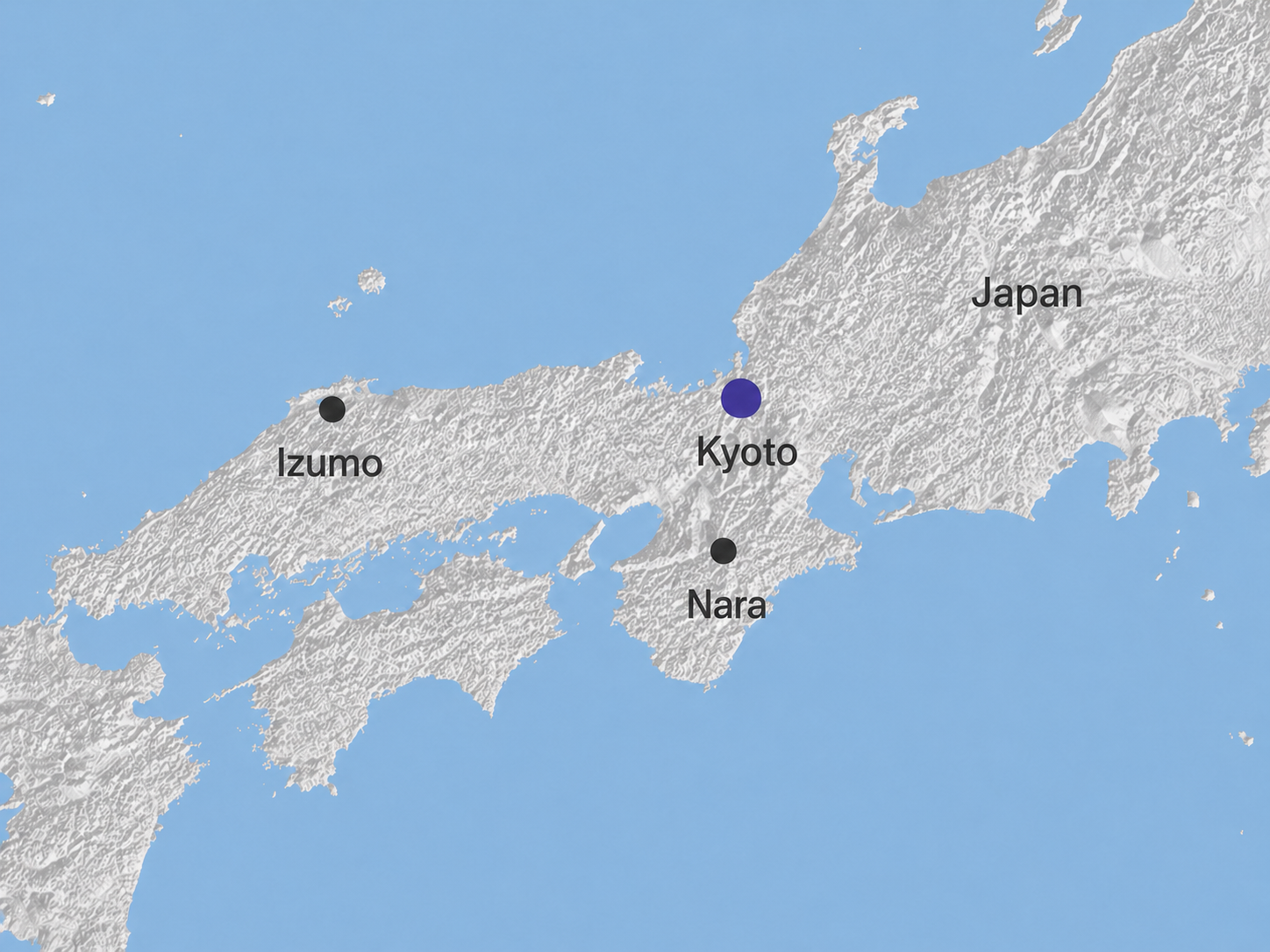
Born on June 15 in Kitamachi, Setoda-cho, Toyota-gun, Hiroshima Prefecture (now Setoda-cho, Onomichi City), as the second son (third child) of Mineichi and Hisano.
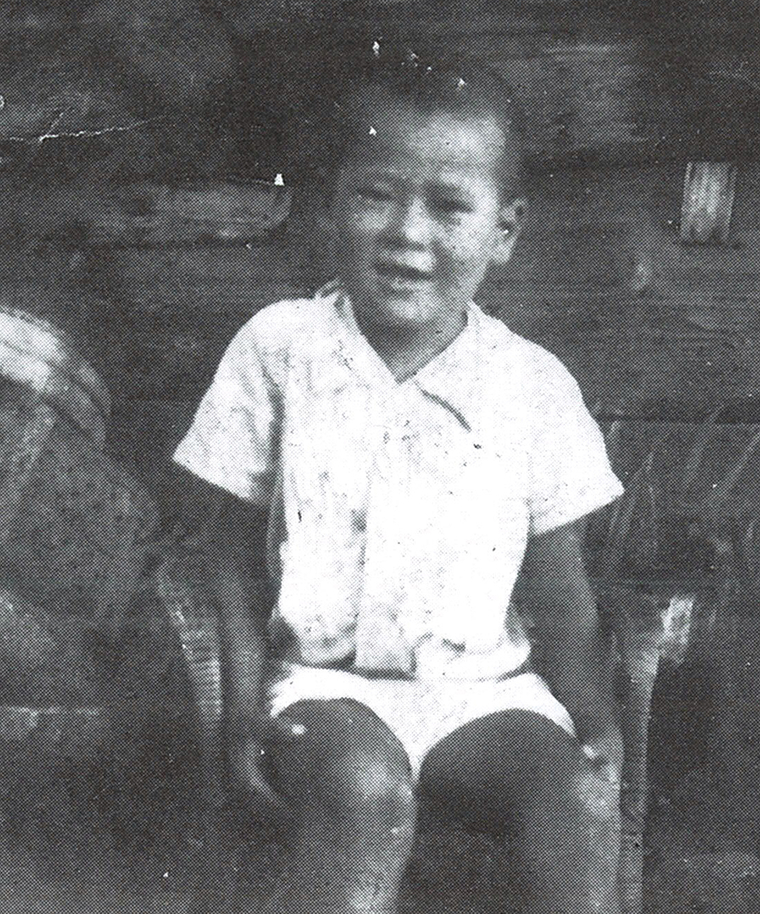
Around 1935, at about age 5
- 1943 (Showa 18)
-
In April, he entered Shudo Middle School in Hiroshima City.
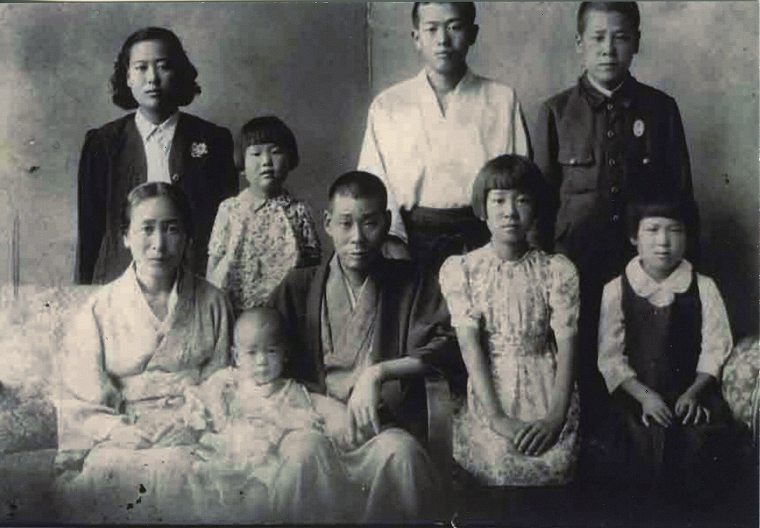
1943, with his family, far right in the back row
- 1945 (Showa 20)
-
On August 6, while in his third year at Shudo Middle School, he was exposed to the atomic bombing while working at the Hiroshima Army Ordnance Depot (3 km from the hypocenter), where he had been mobilized for student labor service.
- 1946 (Showa 21)
-
In February, he transferred to Hiroshima Prefectural Tadanoumi Middle School (now Hiroshima Prefectural Tadanoumi High School).
Ikuo Hirayama: Student Years
- 1947 (Showa 22)
-
In April, he entered the preparatory course of the Department of Japanese Painting at Tokyo Fine Arts School (now Tokyo University of the Arts).
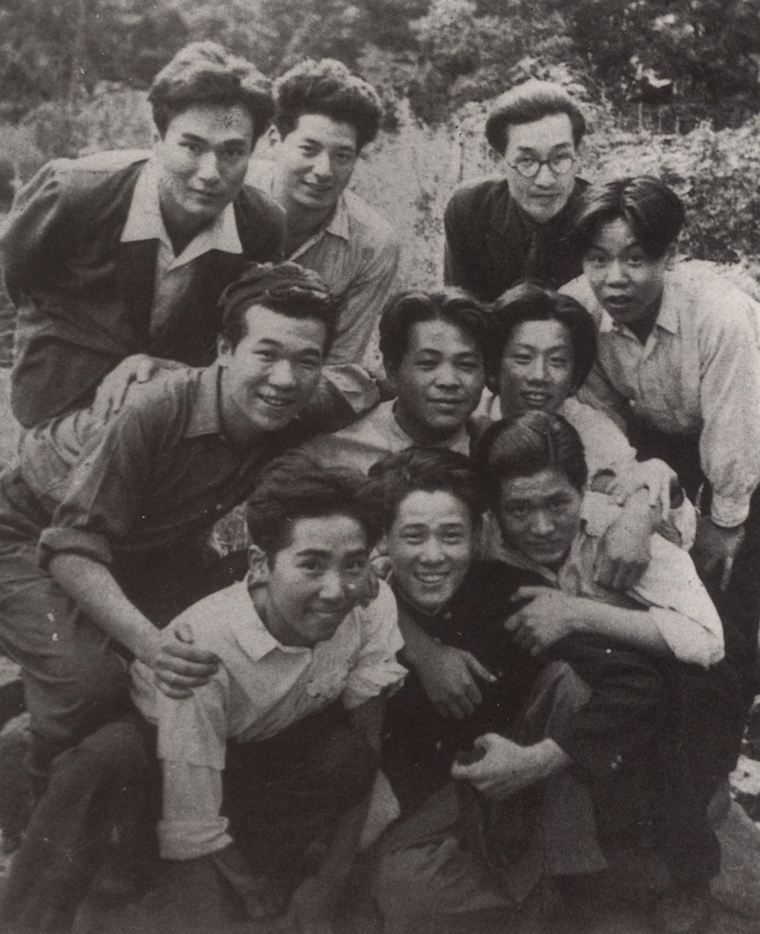
1948, Tokyo Fine Arts School
Ikuo Hirayama in His 30s
- 1952 (Showa 27)
-
In March, he graduated from the Department of Japanese Painting at Tokyo Fine Arts School. His graduation work was Three Sisters (The University Art Museum, Tokyo University of the Arts). In April, he was appointed assistant in the Department of Japanese Painting, Faculty of Fine Arts, Tokyo University of the Arts. The head professor was Seison Maeda.
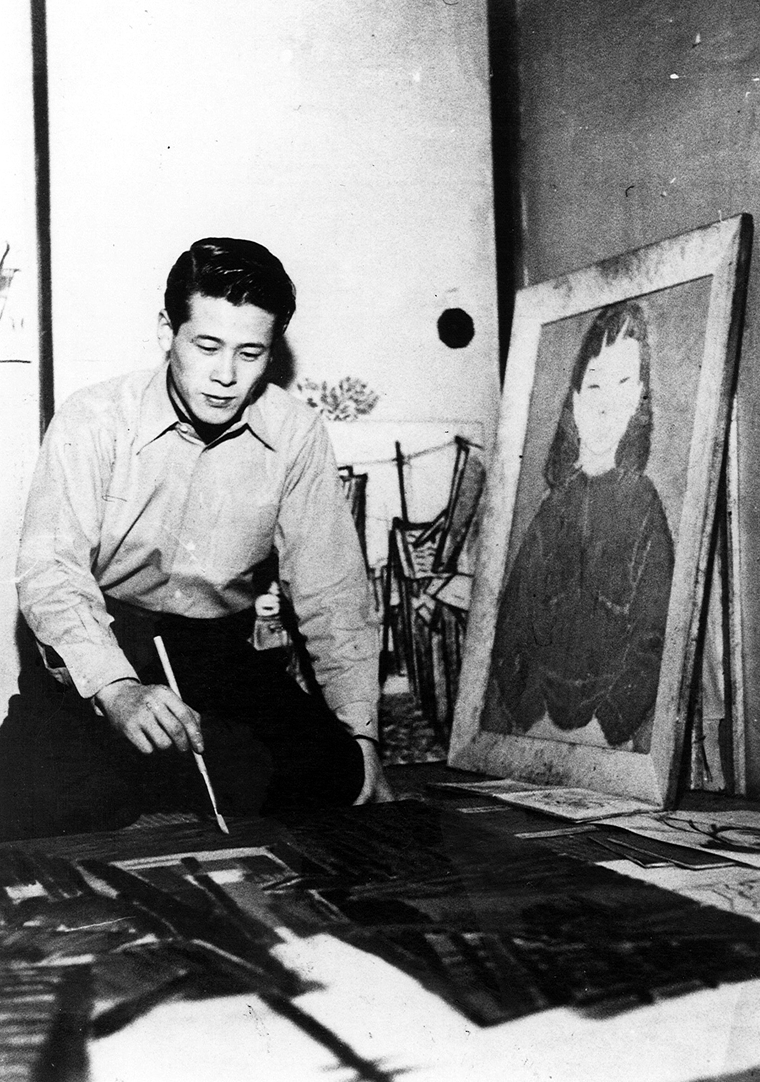
Around 1952, at work in the studio
- 1953 (Showa 28)
-
In September, The Road Home (Hiroshima Prefectural Art Museum) was selected for the first time for the 38th Inten Exhibition (Reorganized Japan Art Institute Exhibition).
- 1955 (Showa 30)
-
On May 7, with Seison Maeda and his wife acting as matchmakers, he married Michiko Matsuyama, a classmate from Tokyo Fine Arts School. The couple set up their new home in a six-tatami room apartment in Futabacho, Itabashi Ward. Early Spring was selected for the 40th Inten Exhibition, and he was recommended as an associate member of the Japan Art Institute.
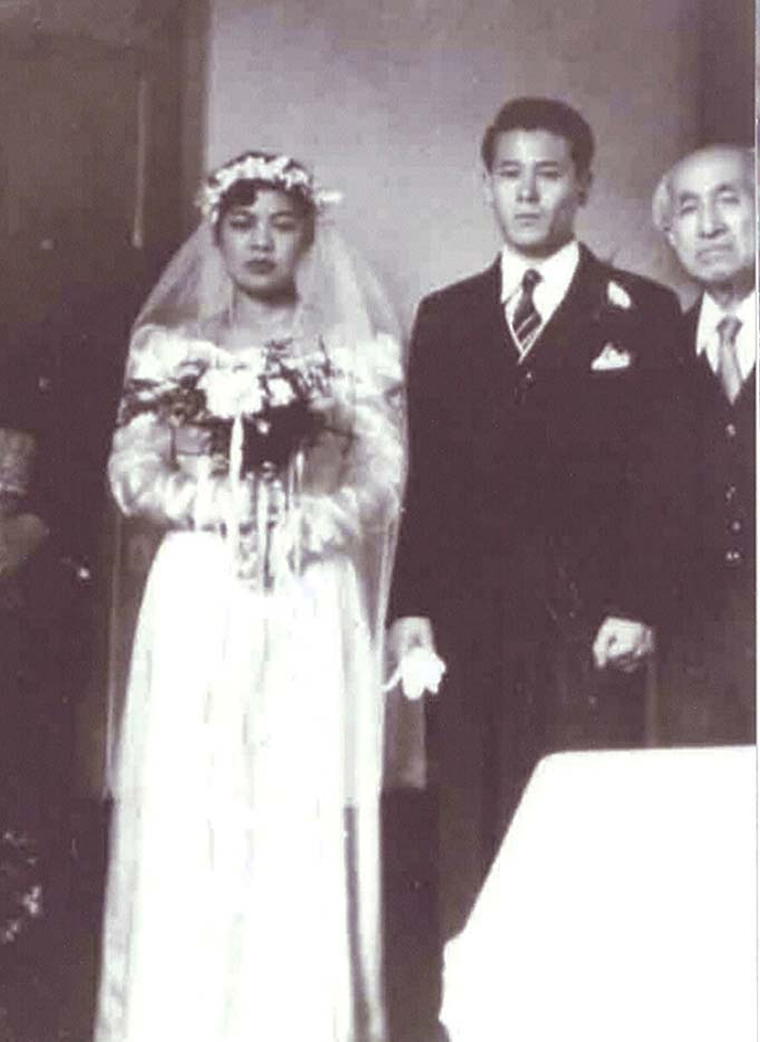
1955, marriage
- 1956 (Showa 31)
-
In September, A Moment of Rest was selected for the 41st Inten Exhibition. In November, his eldest son, Ren, was born.
- 1959 (Showa 34)
-
Around this time, he began to suffer from symptoms of a declining white blood cell count. In March, his eldest daughter, Yayoi, was born. In September, The Transmission of Buddhism (Saku Municipal Museum of Modern Art) was selected for the 44th Inten Exhibition (Reorganized Inten), marking what he himself described as the true starting point of his career as a painter. In December, he built a new studio in Narimasucho, Itabashi Ward, Tokyo, and moved there.
Ikuo Hirayama in His 30s
- 1961 (Showa 35)
-
In September, he exhibited Fantasy of the Nirvana at the 46th Inten Exhibition (Reorganized Inten) and received the Japan Art Institute Award (Taikan Award), and was recommended for special non-juried status.
- 1962 (Showa 37)
-
In October, he departed for Europe on the first UNESCO Fellowship. His research theme was “A Comparison of Eastern and Western Religious Art,” and over six months he visited Italy, France, the United Kingdom, the Netherlands, and Germany. He also received an Encouragement Award for Seven Steps.
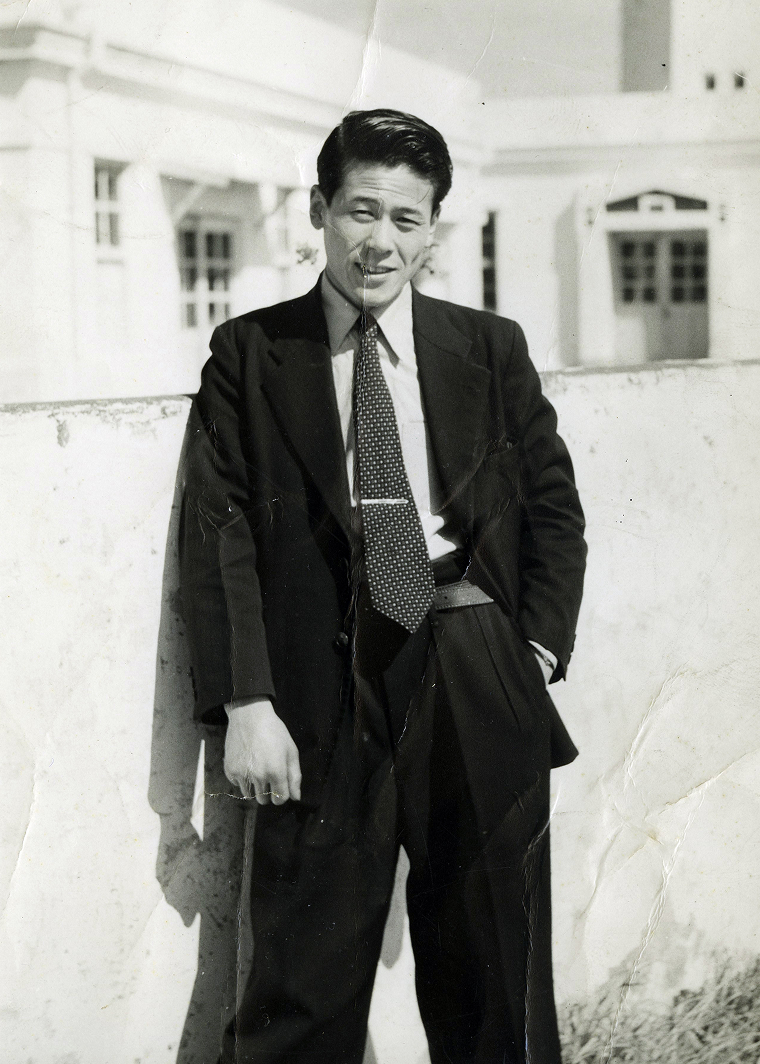
Europe, around 1962 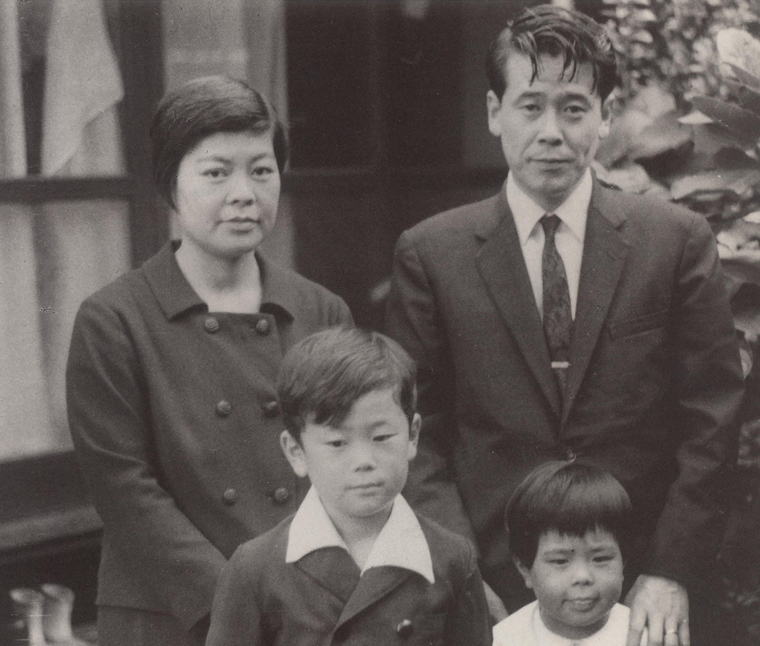
Family photo in front of the Narimasu home, 1962
- 1963 (Showa 38)
-
In June, he was appointed part-time lecturer in the Department of Japanese Painting, Faculty of Fine Arts, Tokyo University of the Arts. A sketch exhibition of European scenes was also held at the university museum.
- 1964 (Showa 39)
-
In June, he was nominated as a full member of the Japan Art Institute. In September, he became a lecturer in the Department of Japanese Painting, Faculty of Fine Arts, Tokyo University of the Arts.
- 1965 (Showa 40)
-
In June, his first solo exhibition was held at Nihonbashi Mitsukoshi.
- 1966 (Showa 41)
-
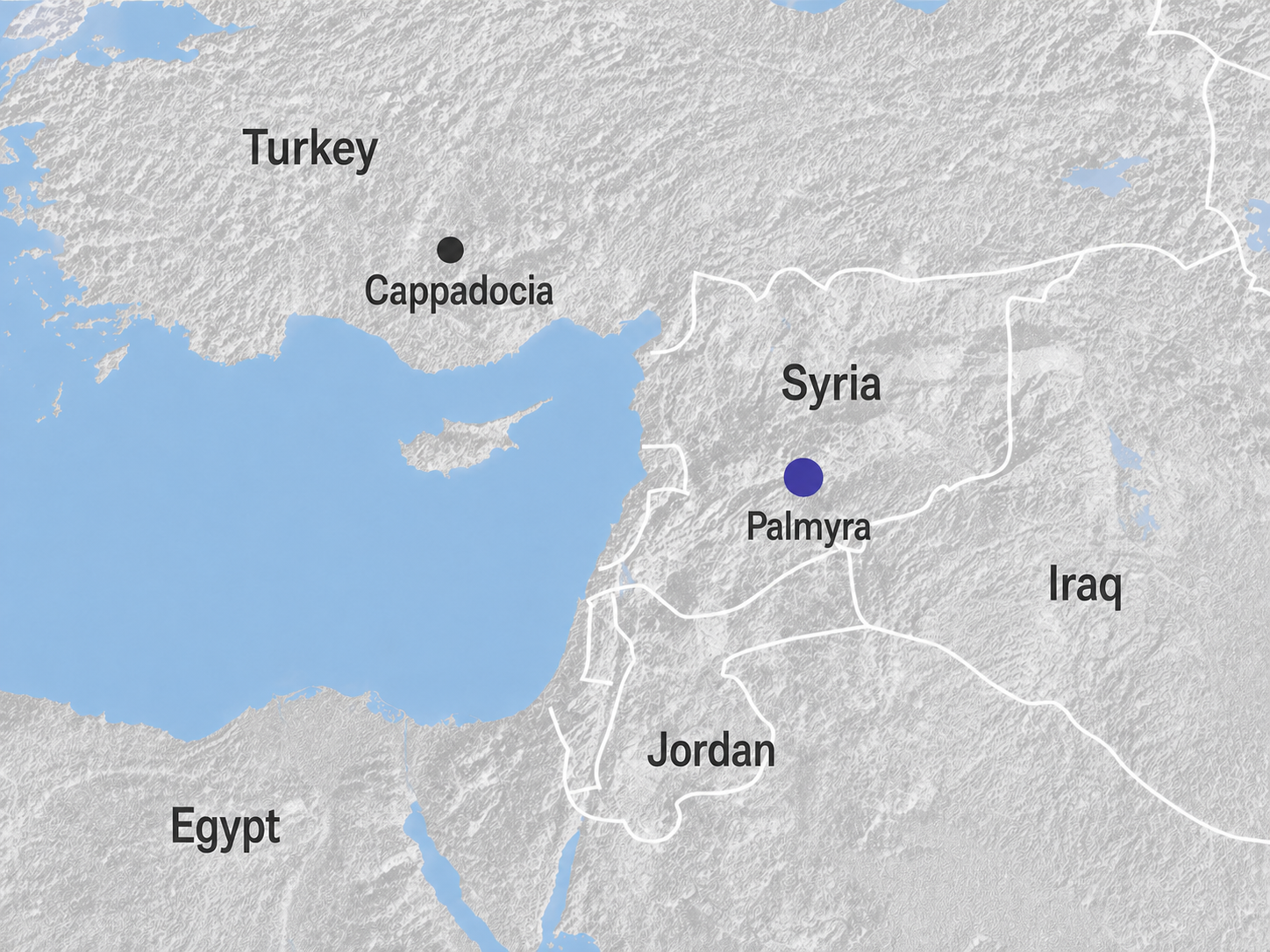
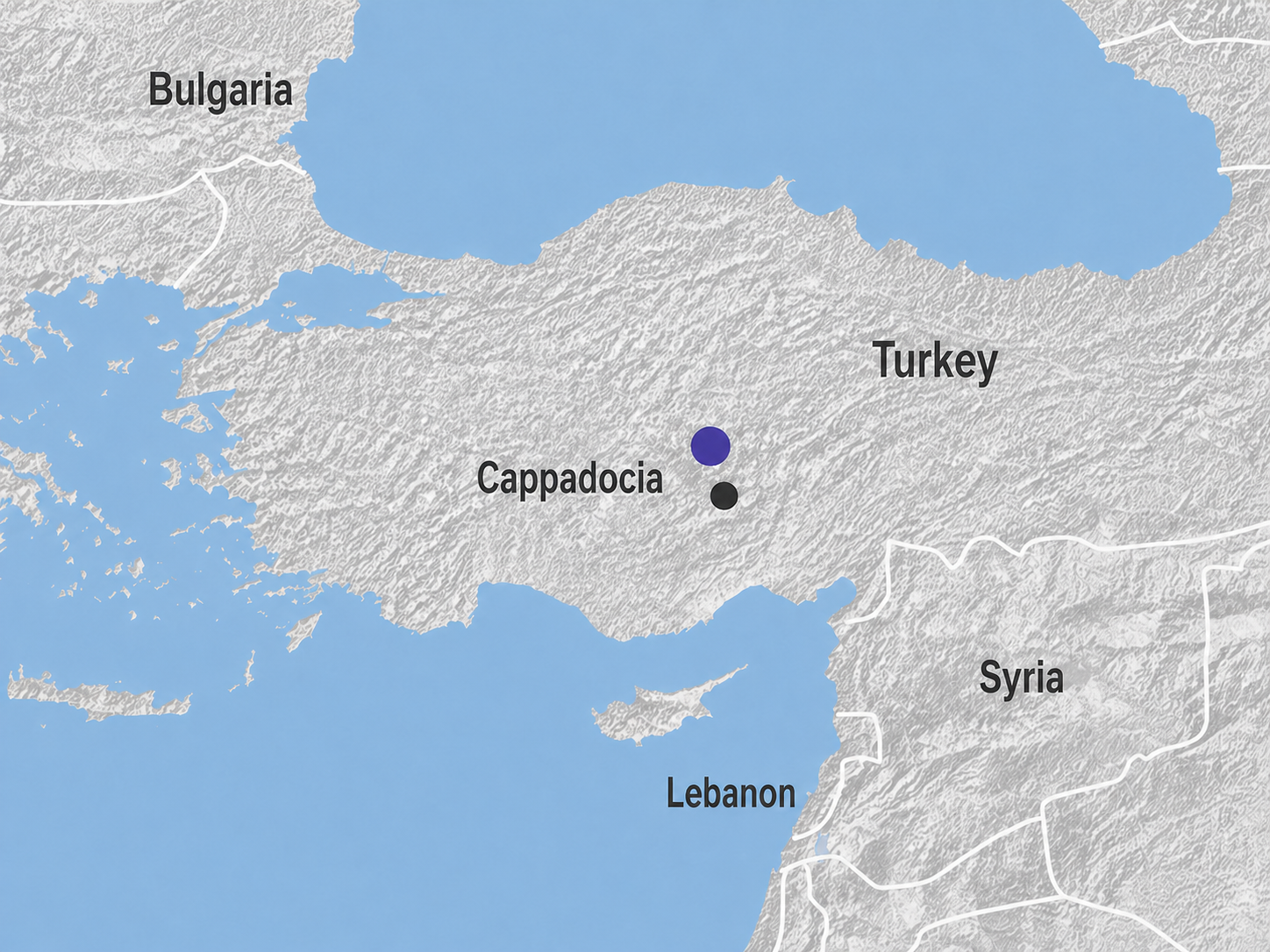
In June, he joined the first Tokyo University of the Arts academic expedition to medieval Near Eastern ruins and copied mural paintings from cave monasteries remaining in the Cappadocia region.
- 1967 (Showa 42)
-
In March, after working for about a year on the reproduction project of the murals in the Golden Hall of Horyuji Temple, he was responsible for Wall No. 3. In September, he exhibited Fantasy of the Tomb Wall of Himiko at the 52nd Inten Exhibition.
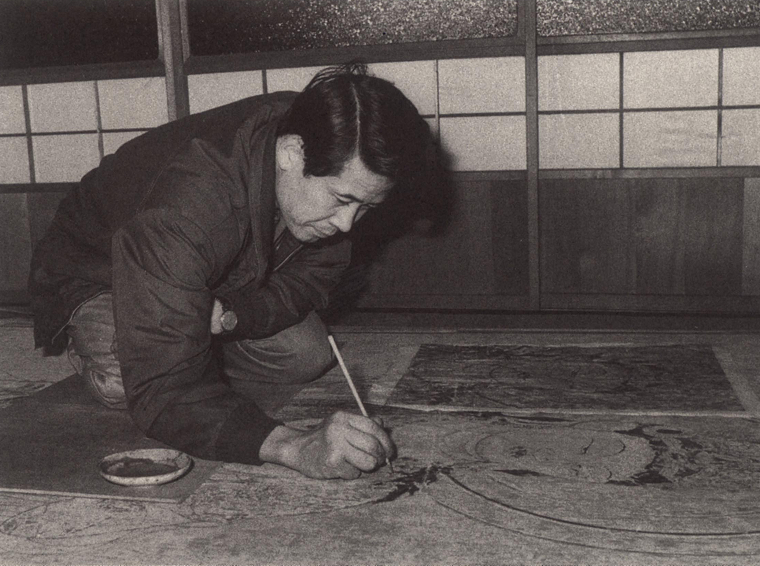
Reproducing the mural of the Golden Hall of Horyuji Temple at his Narimasu home, 1967
- 1968 (Showa 43)
-
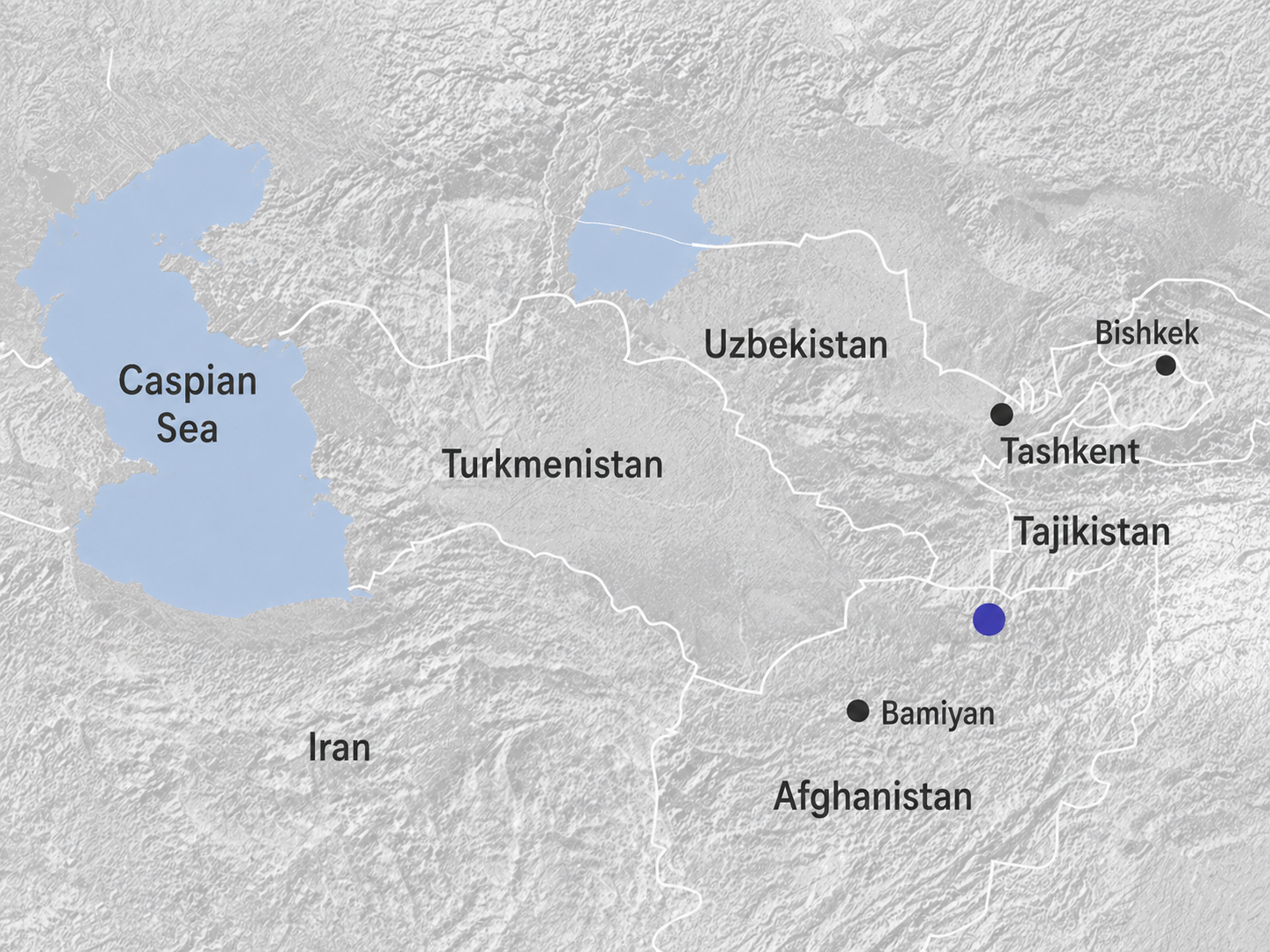
In July, he traveled from Afghanistan to survey ruins in Tashkent, Samarkand, and other sites around the Tien Shan region of Central Asia. This became his first full-scale research journey along the Silk Road.
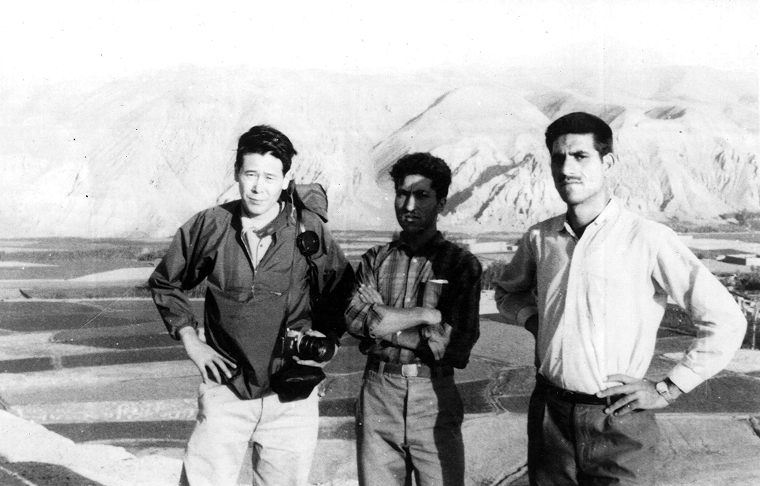
1968, Bamiyan (Afghanistan)
Ikuo Hirayama in His 40s
- 1972 (Showa 47)
-
In August, he built a new studio in Nikaido, Kamakura, Kanagawa Prefecture, and moved there.
- 1973 (Showa 48)
-
In May, he was appointed professor at Tokyo University of the Arts. Also in May, he joined the “Archaeological Expedition along the Route of Alexander the Great’s Eastern Campaign” (led by Namio Egami), traveling overland from Kabul in Afghanistan to Istanbul in Turkey to study Silk Road ruins. In July, he copied murals at the Basilica of Saint Francis in Assisi. In September, he was commissioned by the Agency for Cultural Affairs to create documentary copies of the Takamatsuzuka Tomb murals, and served as head of the copying team until March of the following year.
- 1974 (Showa 49)
-
In September, he traveled to Afghanistan and Pakistan for research. In December, he donated Ancient Eastern Missionaries to the Collection of Modern Religious Art in the Vatican Palace. He was granted an audience with Pope Paul VI and received the Silver Medal of the Order of St. Gregory the Great.
- 1975 (Showa 50)
-
In June, invited by the Chinese People’s Association for Friendship with Foreign Countries, he visited Beijing, Datong, Shanghai, Xi’an, and other cities as a member of a delegation of Japanese artists.
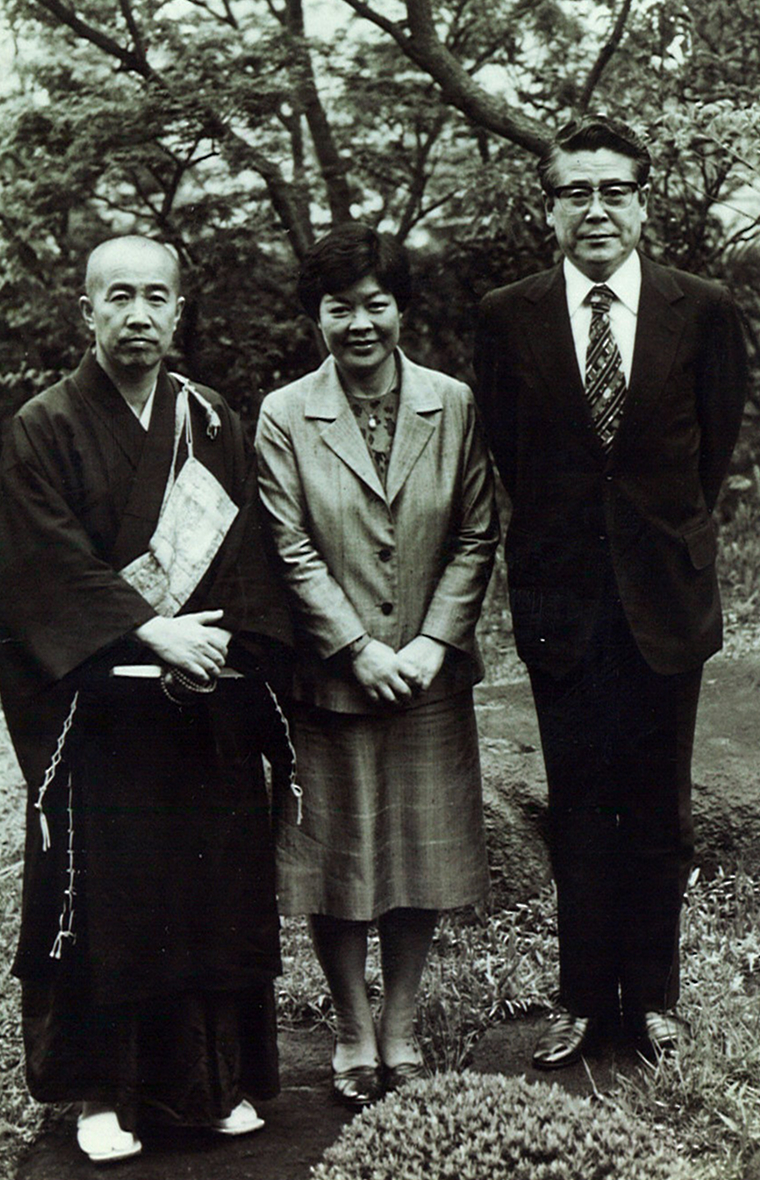
1975, with Reverend Koin Takada of Yakushiji Temple
- 1976 (Showa 51)
-
In April, the Ikuo Hirayama Silk Road Exhibition was held at Takashimaya Nihonbashi.
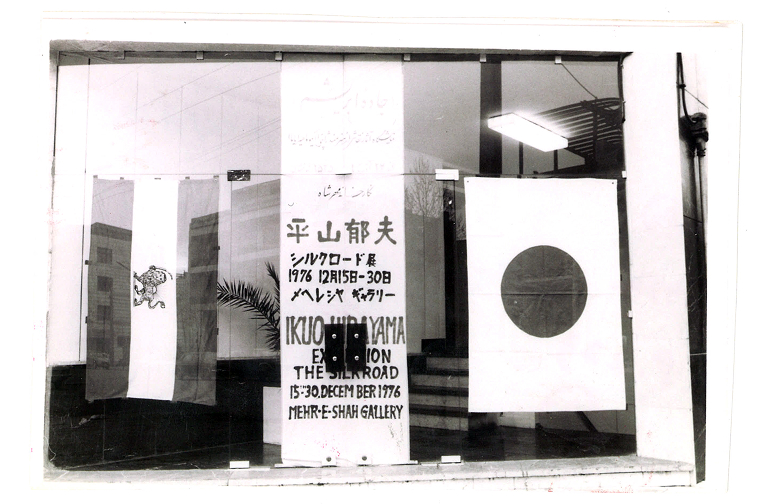
1976, Tehran Exhibition
- 1978 (Showa 53)
-
In May, the exhibition Ikuo Hirayama: Painting China was held at Nihonbashi Mitsukoshi.
- 1979 (Showa 54)
-
In September, he exhibited Hiroshima Transformation Scene (Hiroshima Prefectural Art Museum) at the 64th Reorganized Inten Exhibition. He also visited the Mogao Caves in Dunhuang for the first time.
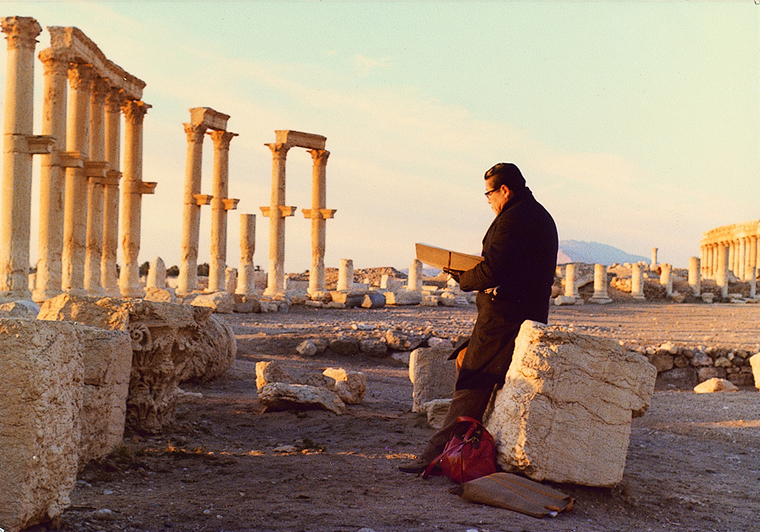
1979, Palmyra
- 1980 (Showa 55)
-
In March, he joined the Borobudur Buddhist Art Inspection Mission. On May 13, the ceremony marking the beginning of work on the mural paintings for the Genjo Sanzoin at Yakushiji Temple, as well as the opening of Ikuo Hirayama’s painting studio, was held. The studio established at his home in Kamakura was named Koan.
Ikuo Hirayama in His 50s
- 1982 (Showa 57)
-
In March, he accompanied graduate students of the Department of Japanese Painting at Tokyo University of the Arts on a study trip of Chinese ancient art, visiting the Palace Museum, the Yungang Grottoes, the Longmen Grottoes, and other sites. In September, he visited China for the preliminary survey of the Tokyo University of the Arts Dunhuang Academic Expedition. He also exhibited Sky over the Silk Road at the 67th Inten Exhibition.
- 1983 (Showa 58)
-
In February, the exhibition Ikuo Hirayama: The Road to Tenjiku was held at Takashimaya Nihonbashi. In September, he led the first Tokyo University of the Arts Dunhuang Academic Expedition to the site.
- 1988 (Showa 63)
-
On June 2, the Foundation for the Promotion of Cultural Property Protection was established, and he became a director. In December, he was appointed UNESCO Goodwill Ambassador.
- 1989 (Heisei 1)
-
In November, as leader of the Japan Loulan Academic and Cultural Mission, he visited Loulan in the Xinjiang Uyghur Autonomous Region of China, where he investigated and documented the ruins. On December 21, he became the sixth president of Tokyo University of the Arts.
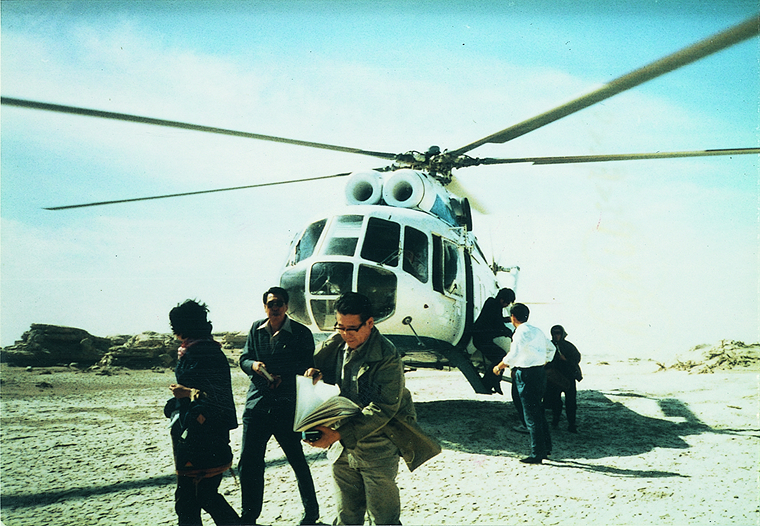
1989, arriving in Loulan by helicopter
- 1990 (Heisei 2)
-
In May, the exhibition Ikuo Hirayama: Journey to Loulan was held at Takashimaya Nihonbashi.
Ikuo Hirayama in His 60s
- 1991 (Heisei 3)
-
In April, he visited Cambodia as leader of the first Angkor Ruins Survey Mission of the Committee for the Safeguarding of Angkor, and conducted research on the Angkor ruins.
- 1992 (Heisei 4)
-
In September, he visited major museums in the United States, France, Germany, and the United Kingdom, and met with their directors to discuss conservation and restoration.
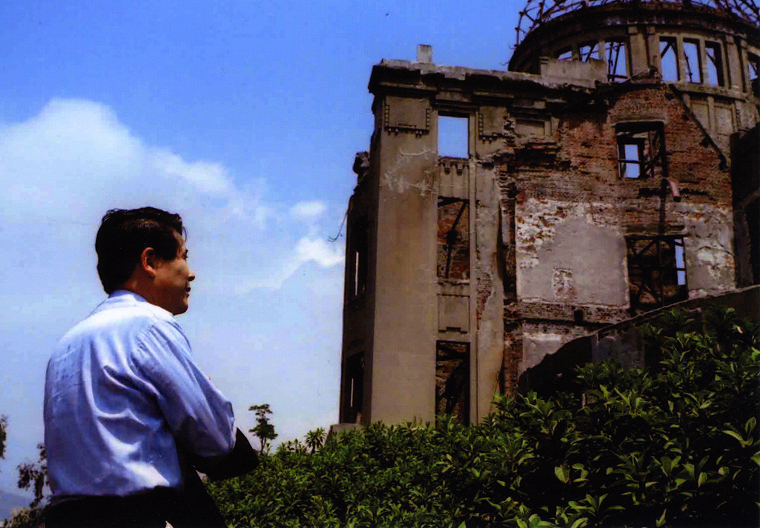
1992, Hiroshima Peace Memorial (Atomic Bomb Dome)
- 1993 (Heisei 5)
-
In August, the exhibition Saving the Angkor Ruins: A Message from Ikuo Hirayama was held at Takashimaya Nihonbashi, and later toured 16 venues in Japan including Tokyo, Osaka, and Nagoya, as well as Paris, Phnom Penh, and Switzerland. In November, he was honored as a Person of Cultural Merit.
- 1994 (Heisei 6)
-
In May, the Ikuo Hirayama Silk Road Exhibition for the Red Cross Fund for World Cultural Heritage was held at Nihonbashi Mitsukoshi and later toured 23 venues. On July 1, he became chairman of the Foundation for the Promotion of Cultural Property Protection. On September 28, he attended the opening ceremony of the Oriental Painting Conservation Studio at the British Museum. On November 21, he attended the on-site opening ceremony for the Angkor ruins restoration project.
- 1995 (Heisei 7)
-
On January 22, he received the Crystal Award at the World Economic Forum in Davos. In May, he attended the opening ceremony of the cooperative project for the conservation and restoration of the Nanjing City Wall, and was named an Honorary Citizen of Nanjing. In September, he was appointed Special Advisor to UNESCO.
- 1996 (Heisei 8)
-
On April 1, he became chairman of the Japan Art Institute. In May, he traveled to Sarajevo for research. On October 20, he was awarded the Ordre national de la Légion d’honneur (Officer) by the President of France.
- 1997 (Heisei 9)
-
On April 6, the Hirayama Ikuo Museum of Art opened in his hometown of Setoda, Hiroshima Prefecture (now Onomichi City). In November, he received a UNESCO Gold Medal.
- 1998 (Heisei 10)
-
In March, the Sagawa Art Museum (Ikuo Hirayama Gallery) opened in Moriyama, Shiga Prefecture. On November 3, he was awarded the Order of Culture.
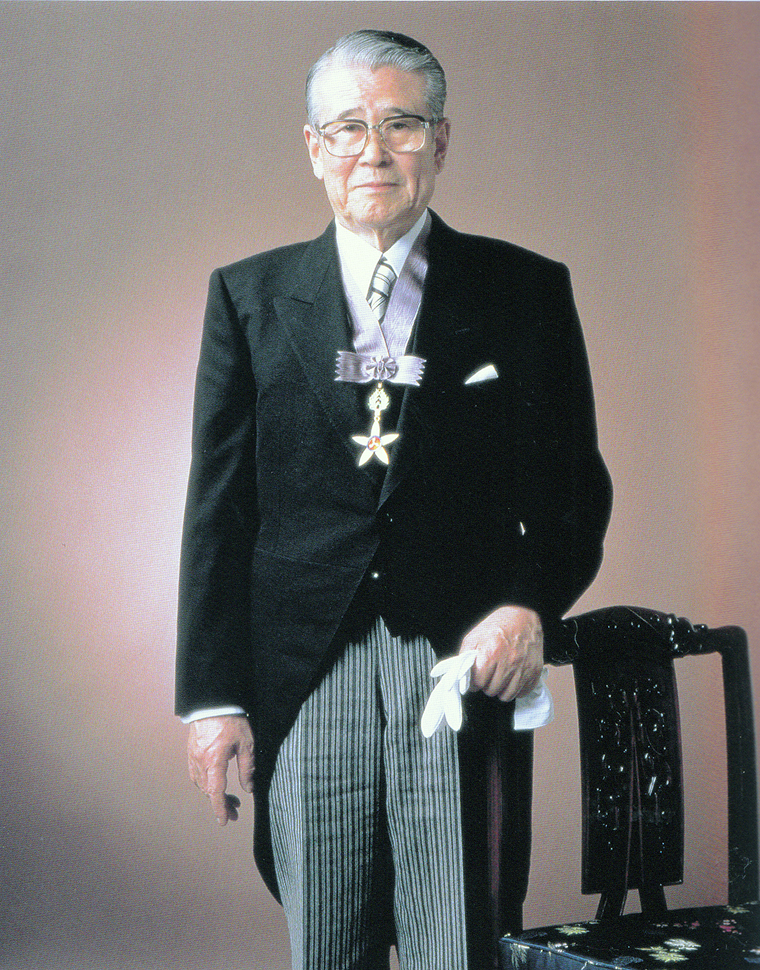
1998, Order of Culture
- 1999 (Heisei 11)
-
In April, he became the first Japanese recipient of the James Smithson Medal from the Smithsonian Institution. In November, he was elected a foreign member of the Institut de France.
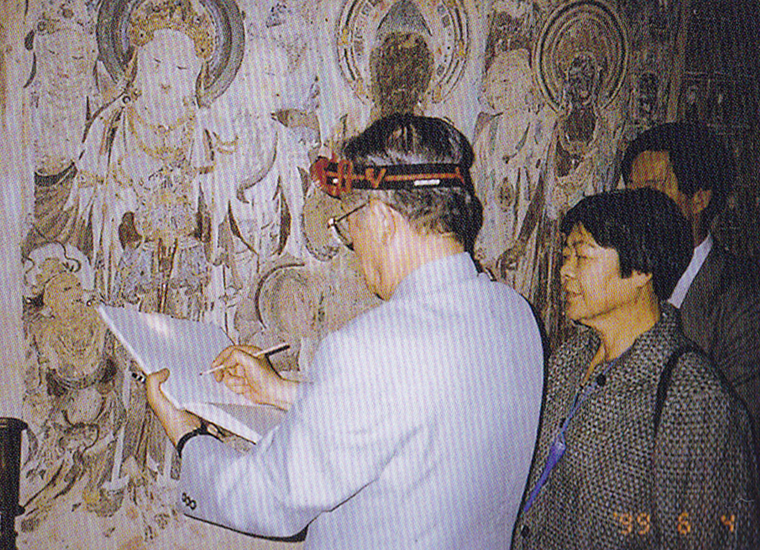
1999, Dunhuang Mogao Caves
- 2000 (Heisei 12)
-
In April, the Yatsugatake Silk Road Museum opened in Yamanashi Prefecture. On December 31, the Great Tang Dynasty Mural of the Western Regions for the Genjo Sanzoin at Yakushiji Temple was completed.
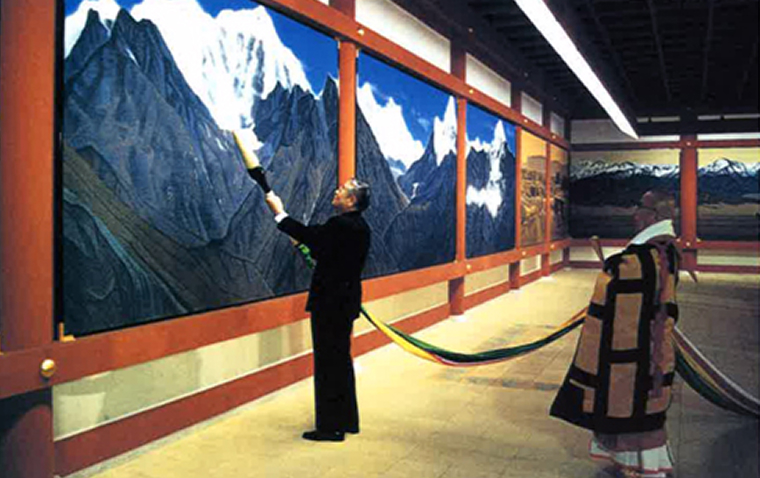
2000, Completion of the “Great Tang Dynasty Mural of the Western Regions”
Ikuo Hirayama in His 70s
- 2001 (Heisei 13)
-
In March, he issued an appeal in protest against the destruction of the Bamiyan Buddhas by the Taliban. In August, he received the Ramon Magsaysay Award (International Understanding category) in the Philippines and attended the award ceremony in Manila.
In October, he received the Japan Foundation Award.
- 2002 (Heisei 14)
-
In May, he attended a UNESCO-sponsored international conference on the restoration of cultural heritage in Afghanistan. In August, he revisited Afghanistan. On September 27, he received the Award for Contribution to Cultural Exchange from the Chinese government.
- 2003 (Heisei 15)
-
In August, the exhibition Protect Endangered Cultural Heritage: Afghanistan and Iraq was held at Nihonbashi Mitsukoshi and later toured seven venues in Japan.
- 2004 (Heisei 16)
-
In January, he received the Asahi Prize. In July, the Complex of Koguryo Tombs was inscribed on the UNESCO World Heritage List. On the 18th, the Hirayama Ikuo Silk Road Museum opened. On December 20, he stepped down as President of Tokyo University of the Arts.
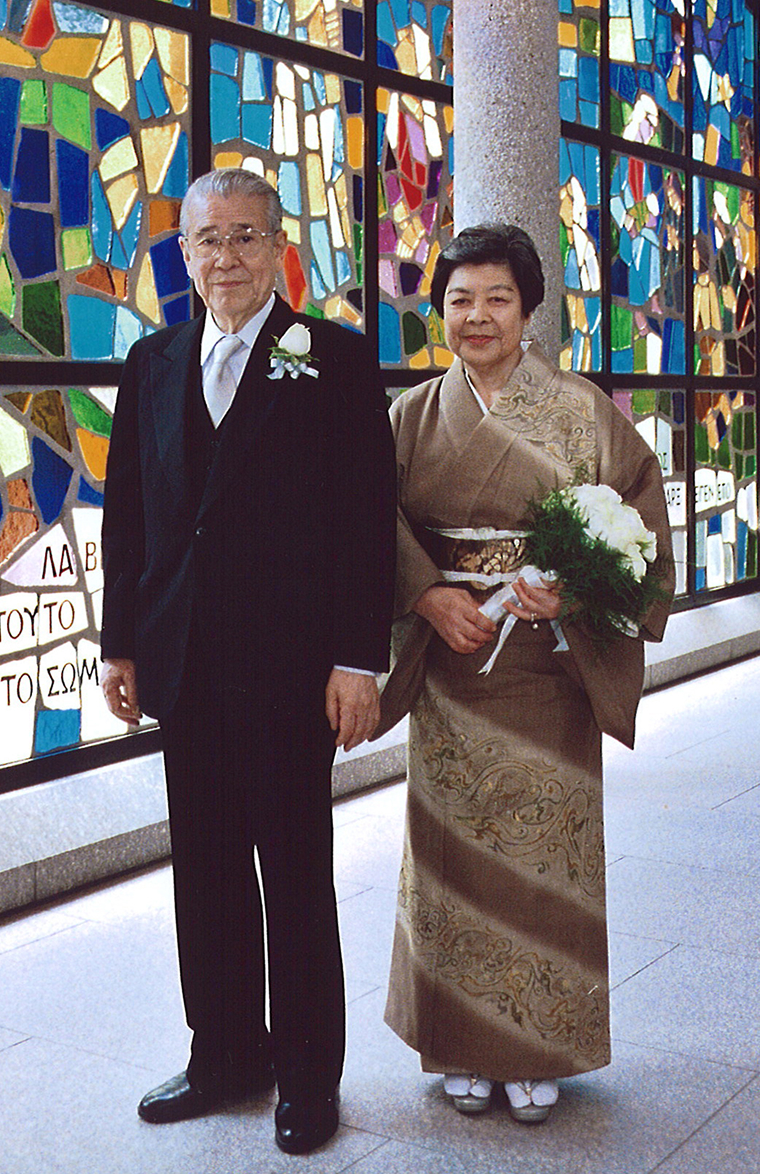
2005, Golden Wedding Anniversary
- 2007 (Heisei 19)
-
In September, the exhibition Ikuo Hirayama: Journey of Prayer was held at the National Museum of Modern Art, Tokyo, and the Hiroshima Prefectural Art Museum.
- 2008 (Heisei 20)
-
In April, the exhibition Ikuo Hirayama Art Exhibition Commemorating the 30th Anniversary of the Japan-China Peace Treaty was held in Beijing, China. The Ikuo Hirayama Silk Road Exhibition commemorating the 150th anniversary of France-Japan relations was also held in Paris, France.
- 2009 (Heisei 21)
-
In September, he exhibited Crossing the Crossroads of Civilizations: Anatolian Plateau, Cappadocia, Turkey at the 94th Reorganized Inten Exhibition. On December 2, he passed away at a hospital in Tokyo at the age of 79. In recognition of his lifetime achievements, he was posthumously awarded the Junior Third Rank.
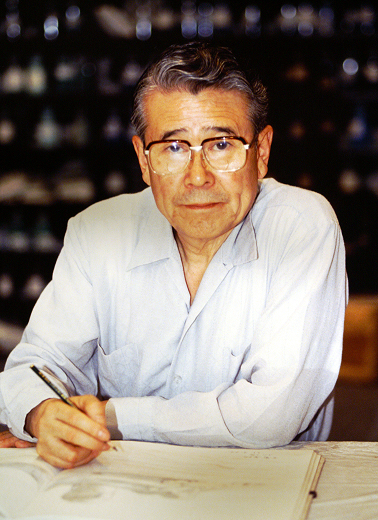
Profile
Ikuo Hirayama
平山郁夫
Born in 1930 in Setoda, Hiroshima Prefecture (now Onomichi City), Ikuo Hirayama graduated from the Department of Japanese Painting at Tokyo Fine Arts School (now Tokyo University of the Arts) and became one of the leading Japanese-style painters of postwar Japan. At the age of 15, he experienced the atomic bombing in Hiroshima, an event that had a profound impact on his life and artistic work, later leading him toward art centered on the theme of peace.
After presenting The Transmission of Buddhism in 1959, he traveled extensively along the Silk Road in search of the roots of Japanese culture, producing many works depicting desert landscapes, camel caravans, ancient ruins, and people of foreign lands. He also placed great importance on international exchange through culture and art, and devoted himself to the protection of cultural heritage around the world. He served as President of Tokyo University of the Arts, Chairman of the Japan Art Institute, and UNESCO Goodwill Ambassador, among other roles. In 1998, he was awarded the Order of Culture. He passed away in 2009 at the age of 79.
Message
The Silk Road was a path forged by countless unnamed people.
It was a road essential to daily life, and people traveled across burning lands for trade.
They probably never imagined that they were contributing to cultural exchange.
Yet in the end, culture was carried by them from West to East, and from East to West.
For those who overcame the fear of death, differences in borders, language, ethnicity, and race must have meant nothing at all.
Both the merchants leading the caravans and the people of the oases needed one another.
At times, violent bandits appeared and great armies swept through, but aside from such things, there must have been genuine friendship among them.
I believe that peace is realized in such places.
Ikuo Hirayama
Excerpt from The Complete Works of Ikuo Hirayama
Passing the Ruins of Palmyra at Night
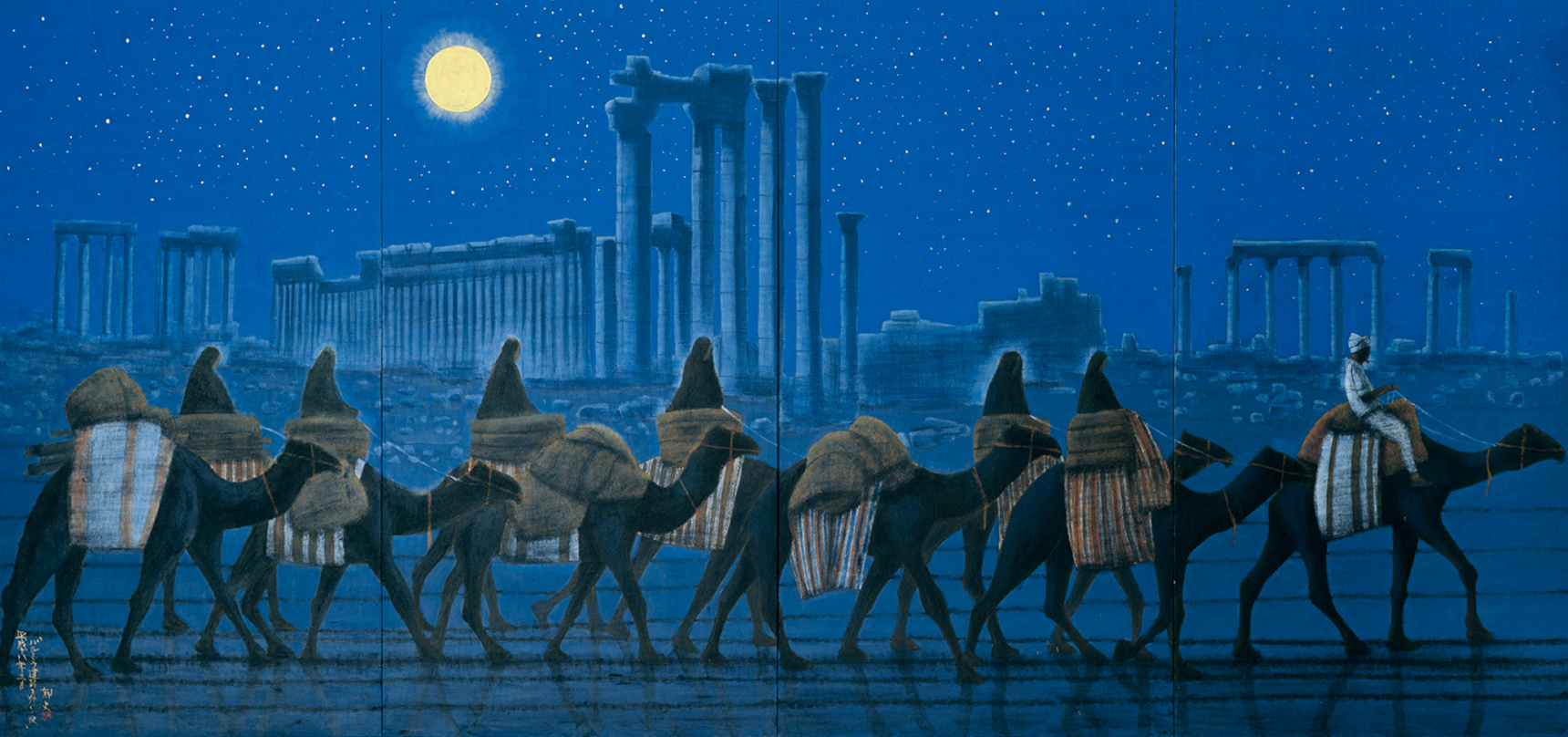
In his later years, Ikuo Hirayama produced a succession of large-scale works in his “Great Silk Road Series,” depicting camel caravans traveling across the deserts of the Silk Road. These works represented the culmination of the Silk Road paintings he had pursued throughout his life, and this painting is one of the most representative among them. Set against the ruins of Palmyra in Syria, the line of camels is vividly contrasted in the orange glow of the morning sun and the deep blue of moonlit night. In recent years, the ruins of Palmyra have been reported destroyed by extremist groups and recaptured by the Syrian army, but in ancient times Palmyra flourished as an oasis city at the height of Silk Road trade.
In the latter half of the 3rd century, after attempting to break away from Roman rule, the city was destroyed by the Roman army, and Queen Zenobia (c. 240–275), leader of the revolt, was captured, bound in golden chains, and paraded through the streets of Rome. It is said that Hirayama, in homage to the tragic Queen Zenobia, depicted only women in black veils riding the camels, with the exception of the male guide. The dreamlike image of desert landscapes and camel caravans that Hirayama continued to paint transcends the ages and stands as a symbol of the exchange of people, goods, and cultures carried out along the Silk Road—an expression of his prayer for peace.
Ancient Roman Ruins, Ephesus, Turkey
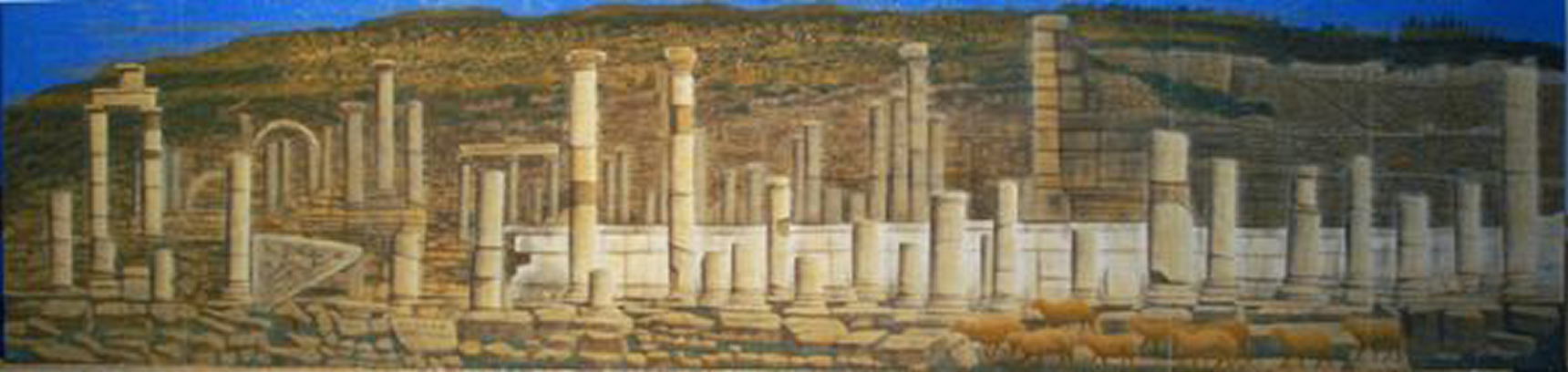
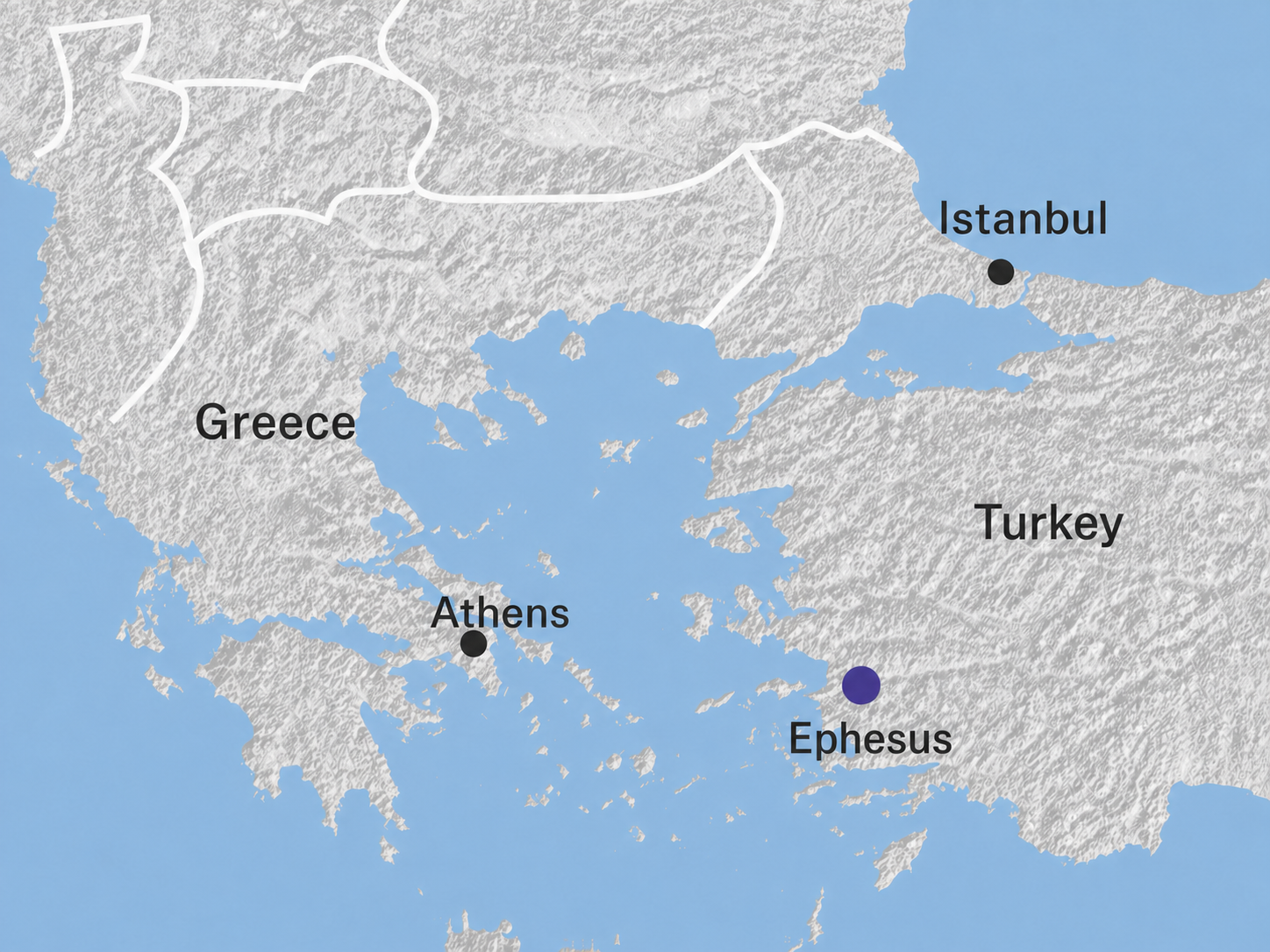
At the front of the large exhibition hall on the museum’s second floor, two works depicting ruins from the Roman era are displayed as the concluding pieces of the Great Silk Road Series (works are rotated depending on the exhibition plan). This painting portrays Ephesus in southwestern Turkey, the largest ancient ruin in Asia Minor, once a port city facing the Aegean Sea. As an ancient Hellenistic city, it continued to prosper as a center of eastern Mediterranean trade even under Roman rule. This work, over seven meters in length, shows the golden mounted army of Alexander the Great soaring above its crumbling colonnades. The great king, who dreamed of the fusion of Eastern and Western civilizations, visited Ephesus in 334 BCE during his great eastern campaign. More than 2,000 years have passed since then, and now delicate wildflowers bloom among the desolate ruins as flocks of sheep wander across them. Hirayama said that by patiently layering paint over time, the depth and weight of history would emerge more fully.
Caravan Traveling the Silk Road — East, Sun
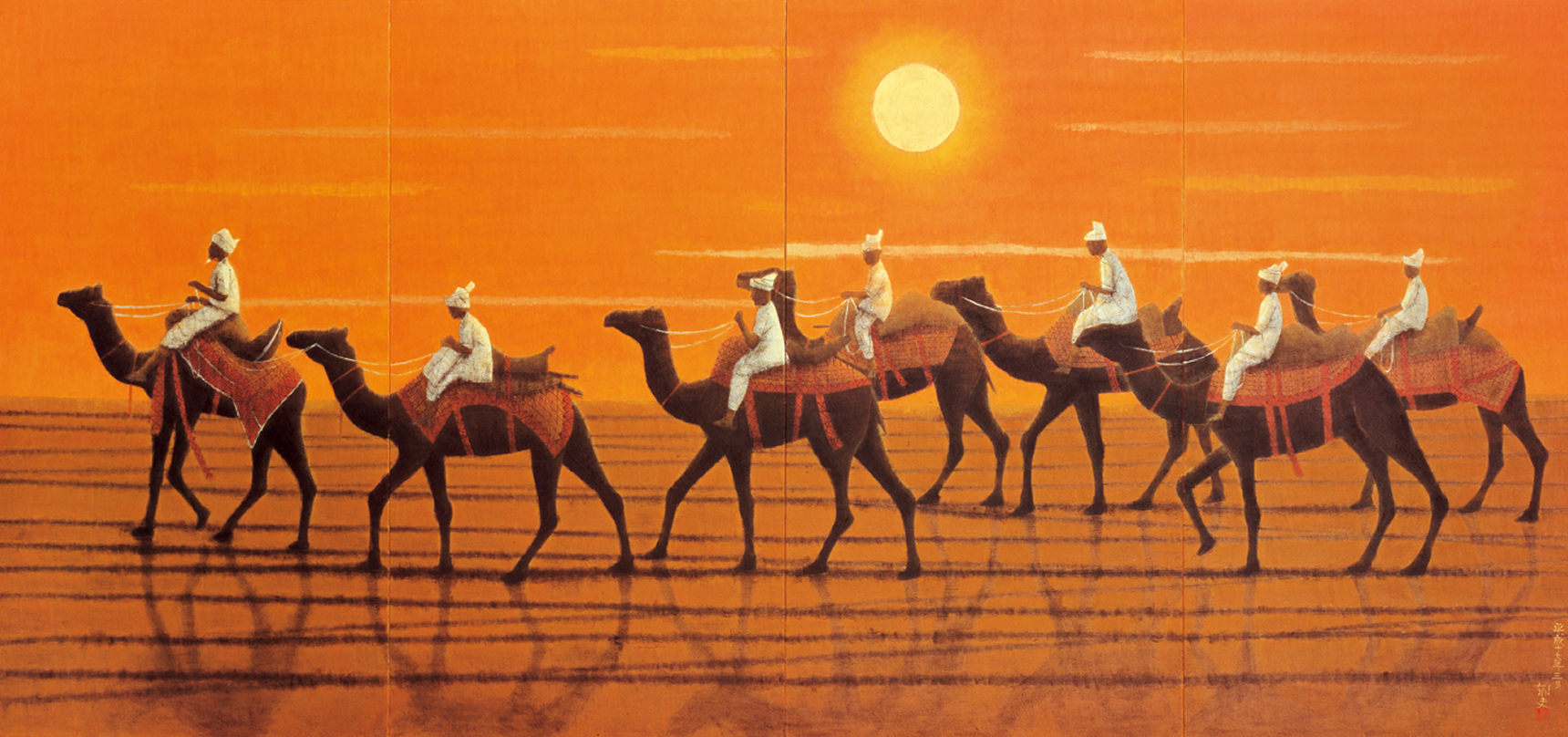
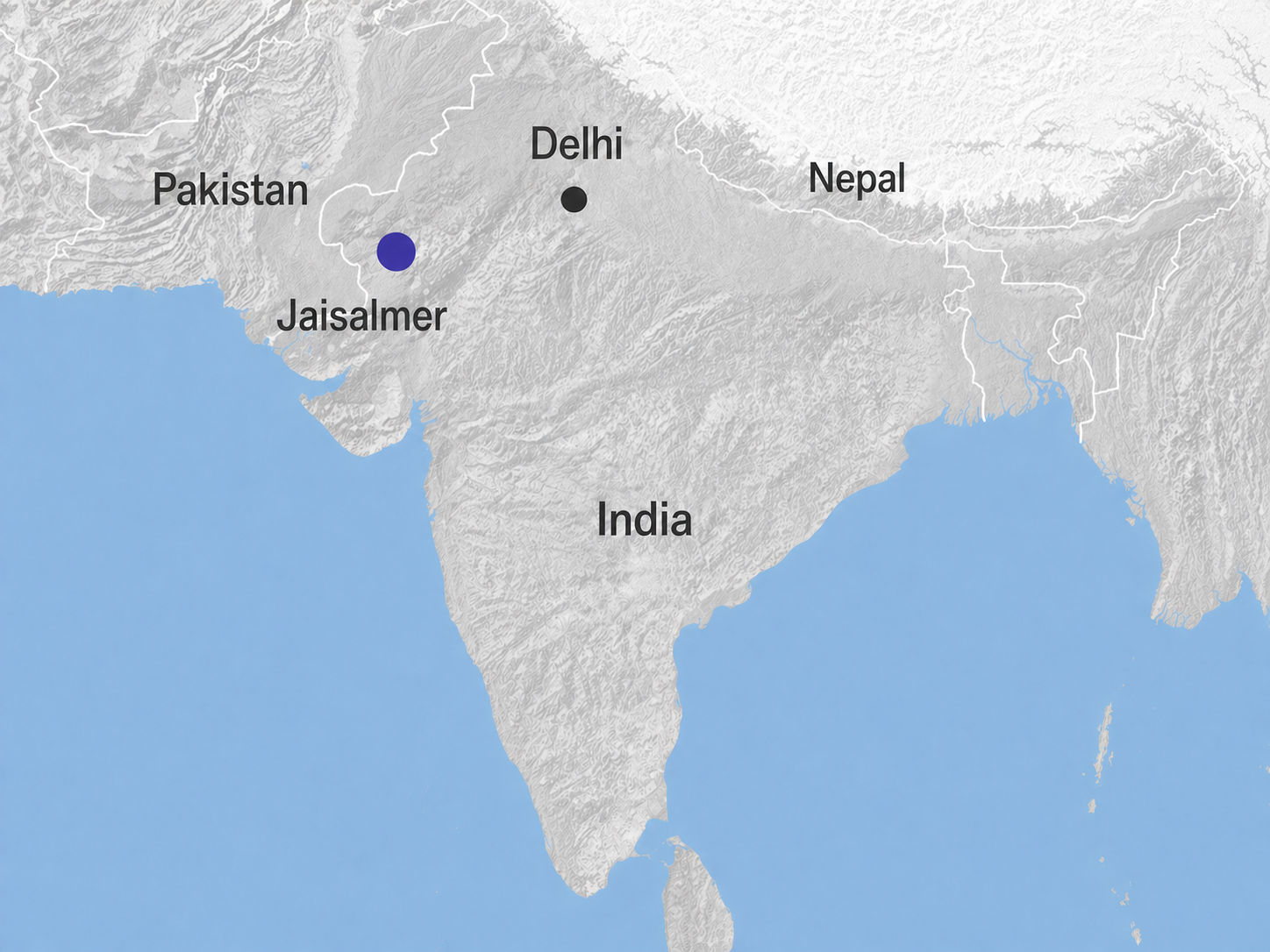
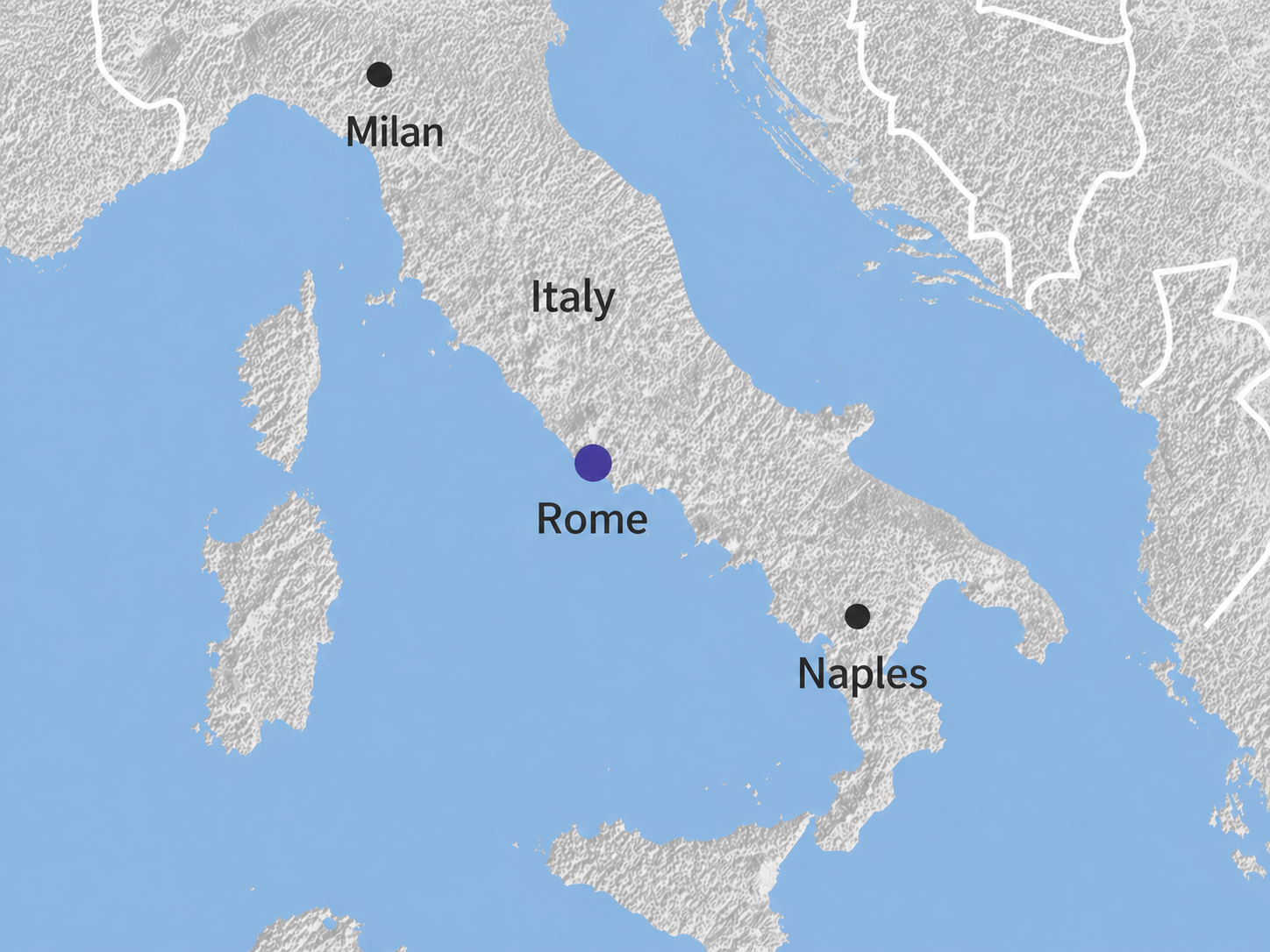
In his later years, Ikuo Hirayama unveiled one after another the works of his “Great Silk Road Series,” depicting camel caravans crossing the deserts of the Silk Road. This series may be regarded as the culmination of the Silk Road paintings he pursued throughout his life. In the series, works dominated by deep blue and orange are paired together, contrasting night and morning, moon and sun, East and West. The camel caravans move from east to west against the backdrops of Loulan, Afghanistan, Jaisalmer in India, and the ruins of Palmyra in Syria. Ahead of the caravan lie Turkey, Ephesus at the far edge of the Eurasian continent, and finally Rome, the endpoint of the Silk Road. Hirayama began painting this series around the time the museum opened and continued until the final Inten Exhibition of his life in 2009. In total, the series consists of twelve works, displayed in the large exhibition hall on the second floor (works are rotated over time).
Ancient Roman Ruins, Foro Romano
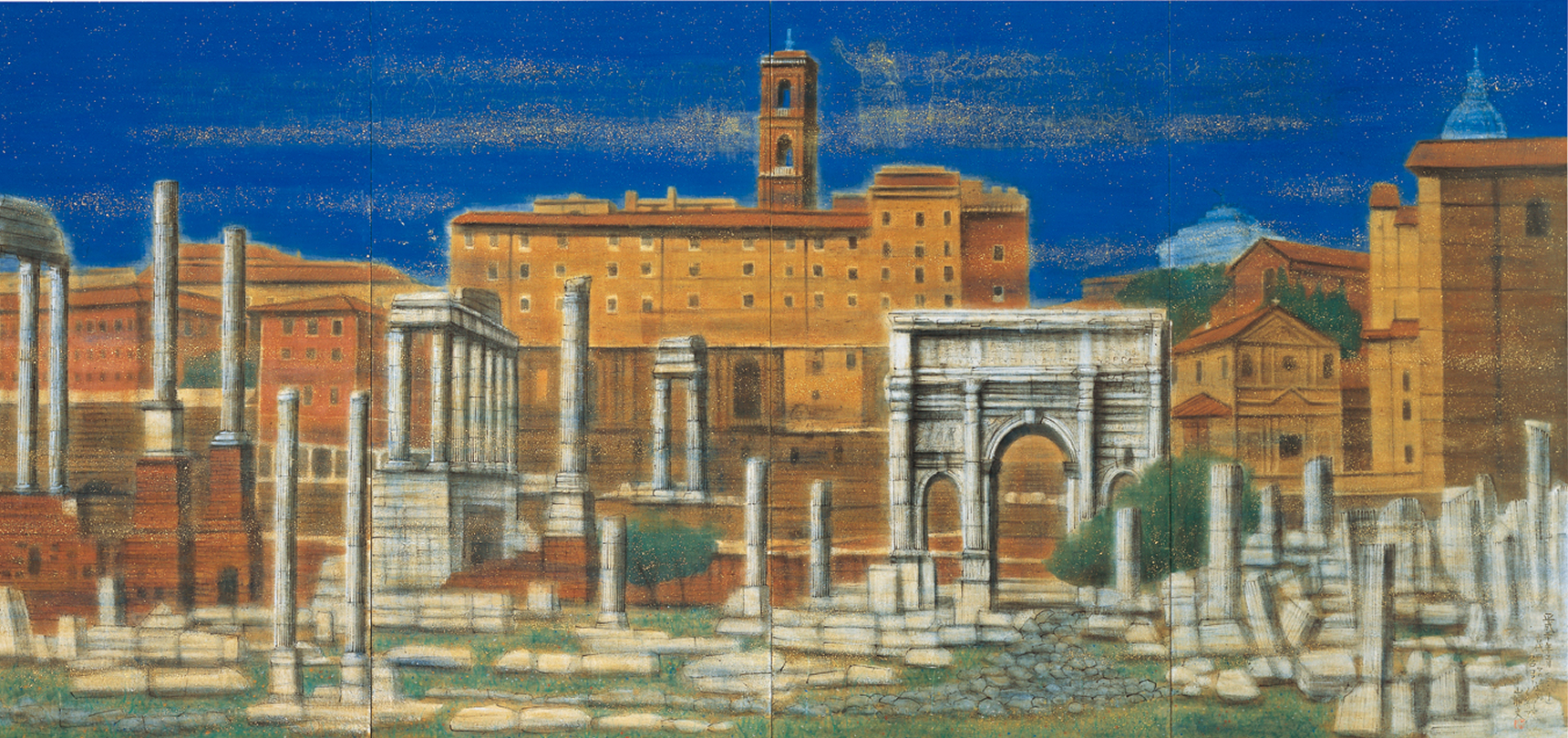
At the front of the large exhibition hall on the museum’s second floor, two works depicting ruins from the Roman era are displayed as the concluding pieces of the Great Silk Road Series (works are rotated depending on the exhibition plan). This painting shows the Foro Romano, once the political and economic center of the ancient Roman Empire. Within these ruins lie many traces of the glory and splendor of successive emperors. The large marble arch seen at the center is the Arch of Septimius Severus. Against the deep blue sky, the figures of Augustus, the first Roman emperor, and the soldiers of the Roman army he led are faintly depicted. The flourishing state of the period can be sensed through the many large-scale remains, including a grand theater built in the 3rd century BCE that could accommodate 25,000 people.
Scenes In and Around Kyoto in the Heisei Era (Right Screen)
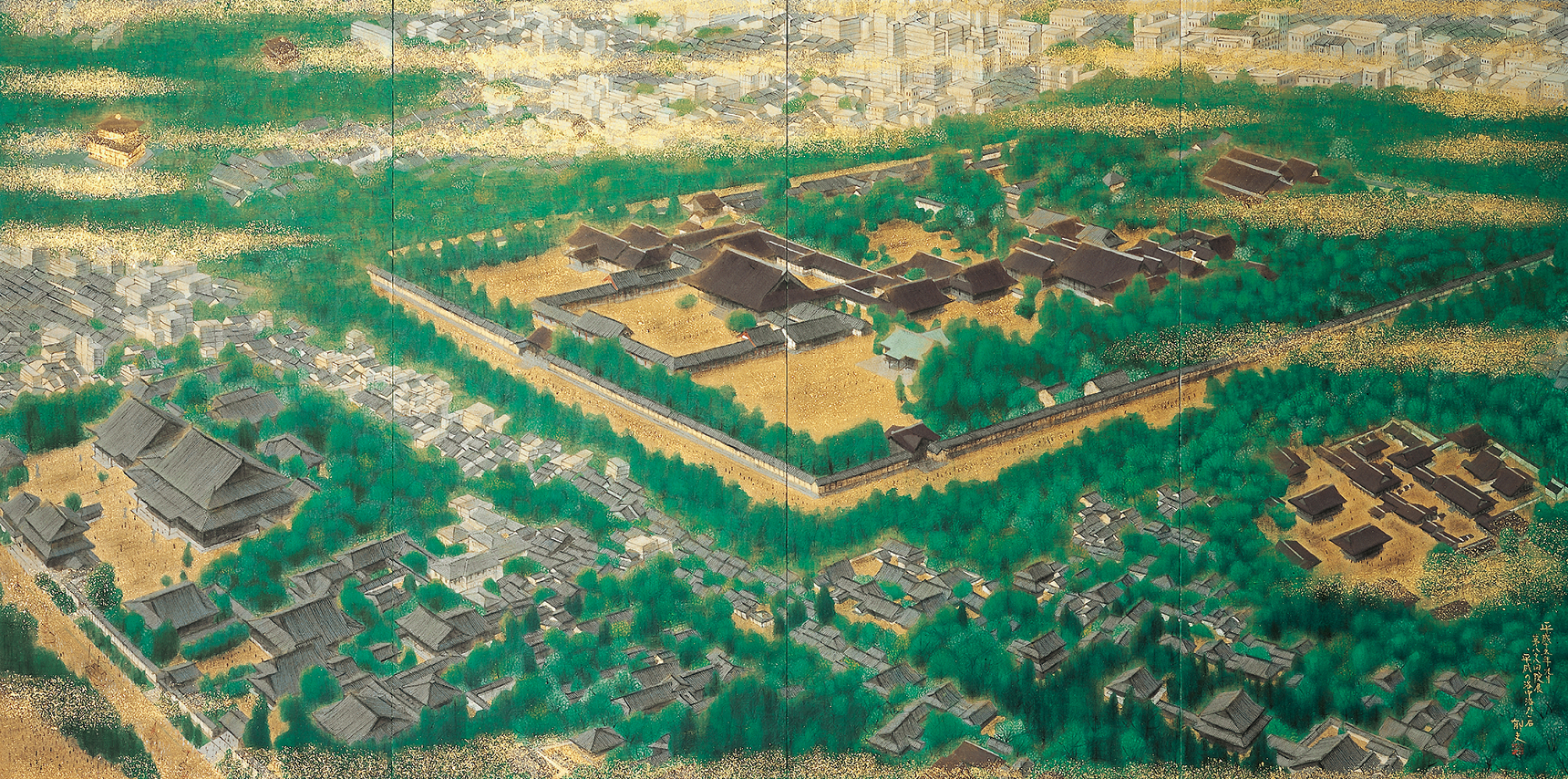
In Japan’s Muromachi period, there existed a painting theme known as Rakuchu Rakugai-zu, or “Scenes In and Around the Capital.” These paintings depicted, in bird’s-eye view, famous places in Kyoto, then the capital, along with shrines, temples, annual events, and the lives of ordinary townspeople. Ikuo Hirayama also created works on this traditional theme, producing Scenes In and Around Kyoto in the Heisei Era (Right Screen) in 2003 and Scenes In and Around Kyoto in the Heisei Era (Left Screen) in 2004. Alongside these works, the artist also turned his attention to individual landmarks, shrines and temples, and the people who sustain the traditional culture of Kyoto. It is said that this idea came to him around the time he was completing The Great Tang Dynasty Mural of the Western Regions (2000, Genjo Sanzoin at Yakushiji Temple), which may be regarded as the culmination of his Silk Road works. After continuing his journeys along the Silk Road in search of the roots of Japanese culture, Hirayama now turned his gaze once again to Kyoto, the ancient capital of Japan. The inspiration that led him to depict Rakuchu Rakugai in a contemporary form came, he said, from the thought: “Though times change and people change, this city that nurtured Japanese culture remains for us an eternal capital. The city of Kyoto, recognized by the world as ‘culture,’ may be said to be a work of art created by the Japanese people over many long years. We must proudly and safely pass this city on to the next generation.” He went on to say, “With boundless gratitude and love for the city of Kyoto, I took up my brush. I wished to leave behind, with my own hand, the Kyoto of my own lifetime. I have given the collective title ‘Scenes In and Around Kyoto in the Heisei Era’ to these works.”
Black Dust in the Scorching Sands
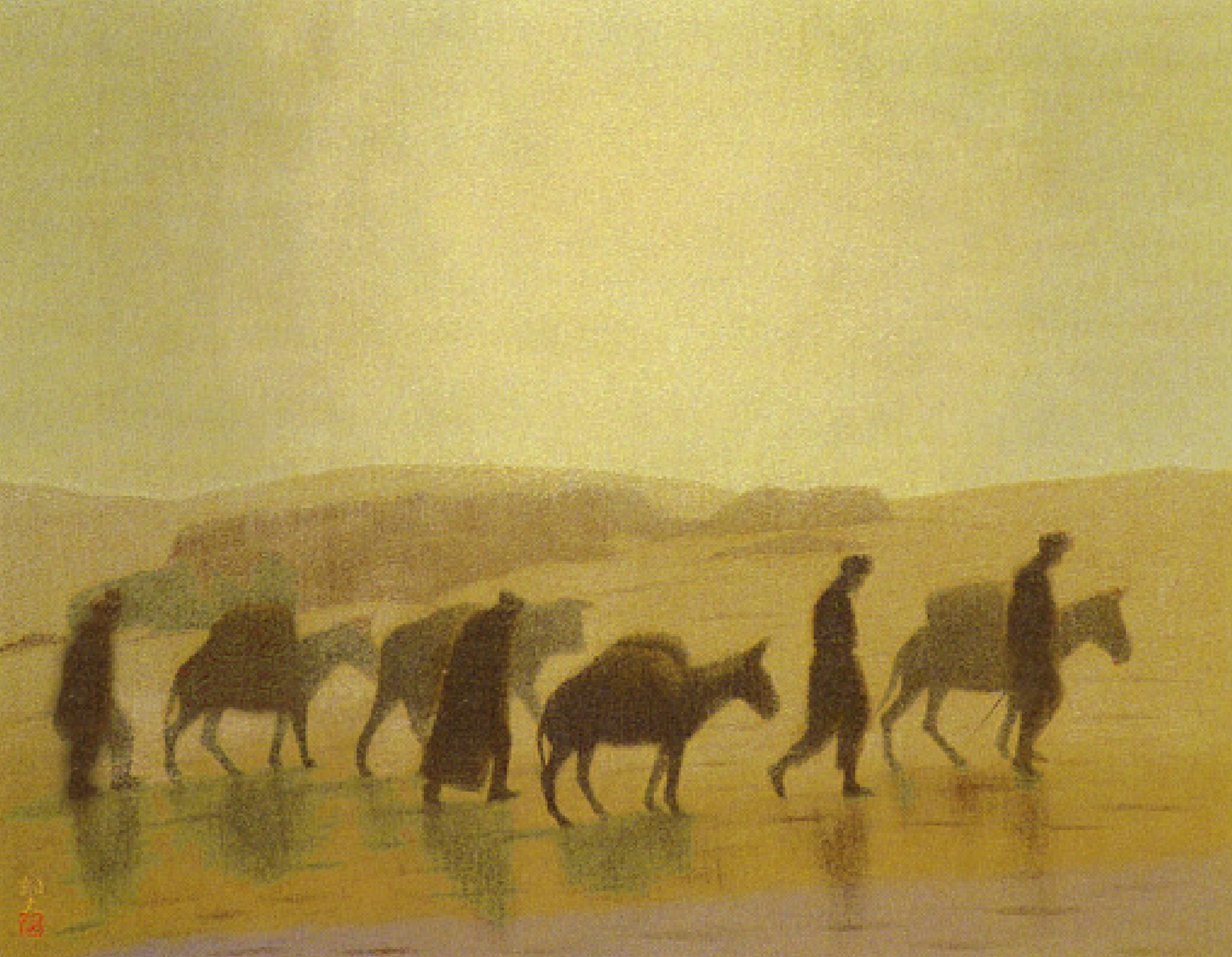
Words of the Artist
Beyond the dust storm, where one cannot see even a short distance ahead, the long road continues. In the midst of the sandstorm, the caravan steadily presses on, traveling endlessly back and forth. This work was painted with the feelings such a way of life stirred in me—at times something close to admiration.
Crossing the Crossroads of Civilizations: Anatolian Plateau, Cappadocia, Turkey
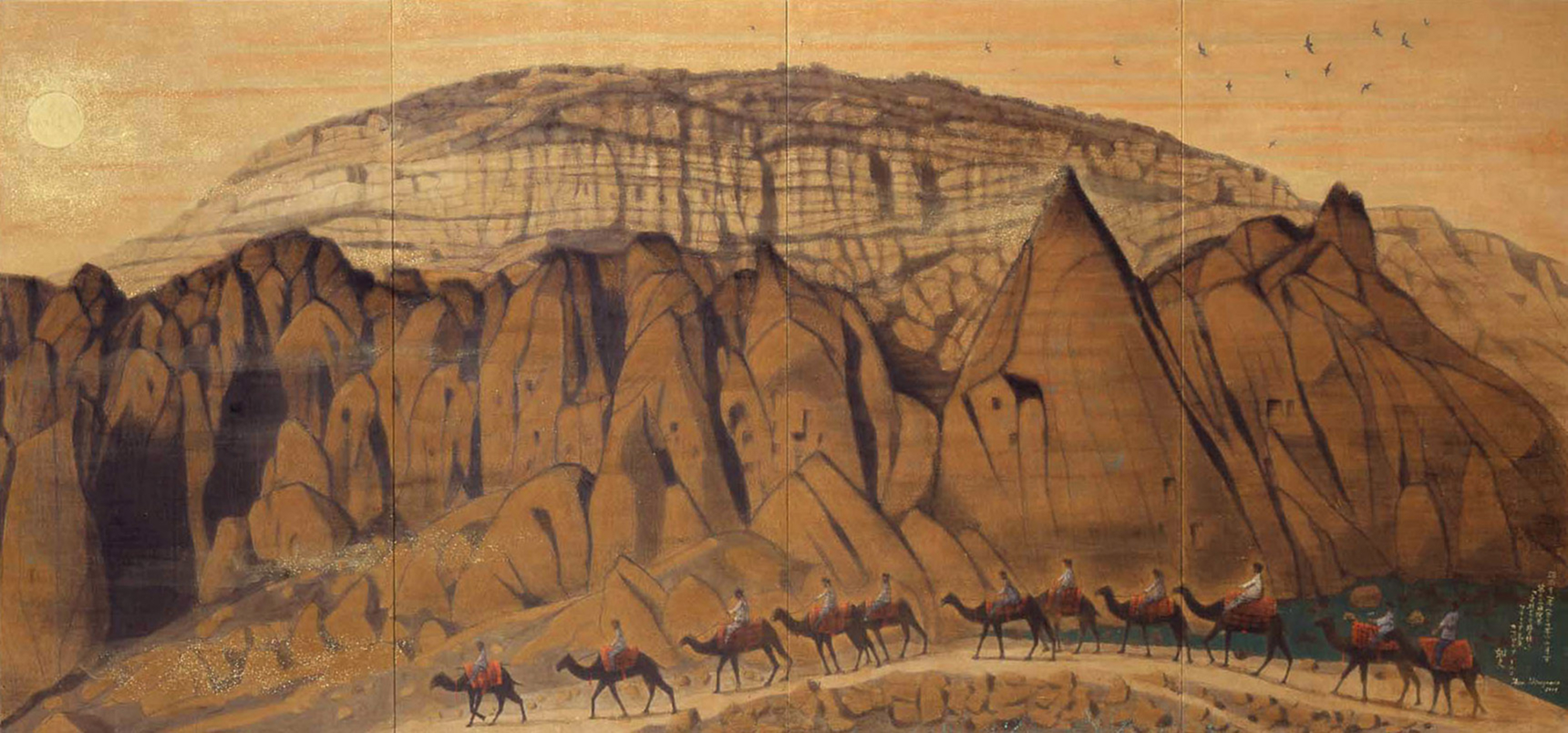
Cappadocia stretches across the heart of the Anatolian Plateau at an elevation of over 1,000 meters. It is a spectacular landscape where soft and hard layers of earth overlap, and countless strange rock formations have been created through erosion. In the 3rd century, Christian monks fleeing persecution by the Roman Empire hollowed out the soft rock and hid there. Over the following centuries, Christians, constantly threatened by Persian and Islamic powers, went on to build underground cities and monasteries one after another. Against the backdrop of Cappadocia’s massive rock formations, a camel caravan passes by. The camels’ steady progress may be seen as a symbol of the peoples and cultures that traveled through this crossroads of civilizations.
Shortly before his death, despite illness, Ikuo Hirayama completed this work and exhibited it at his final Inten Exhibition (the 94th). Earlier in his life, in 1966, at the age of 36, he took part in the Tokyo University of the Arts academic expedition to medieval Near Eastern ruins, where he copied mural paintings in the cave monasteries of Cappadocia. He later recalled that this first stay along the Silk Road inspired what would become the central theme of his life’s work. Fittingly, the last major work of his life also took Cappadocia as its subject.
Unceasing Flowing Waters (Oirase Gorge)
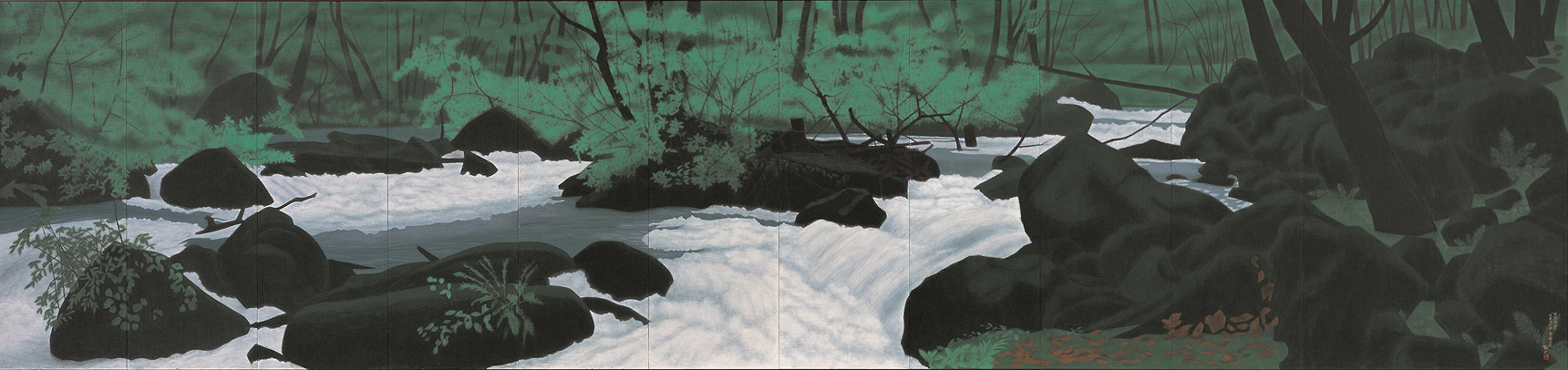
Ikuo Hirayama is widely known as a “painter of the Silk Road,” but he also created many fresh and vivid depictions of Japanese landscapes.
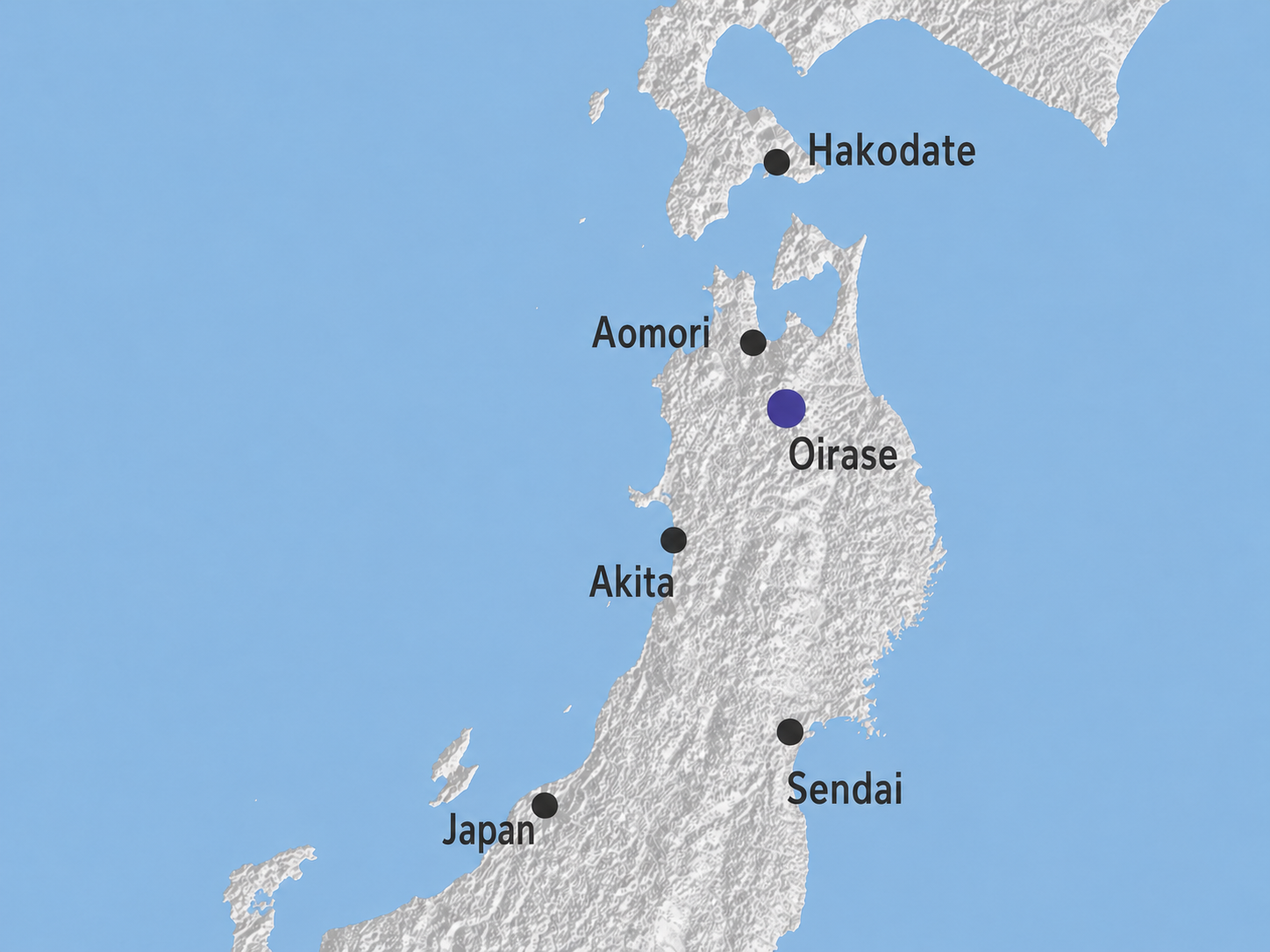
In 1959, when he was a young assistant at Tokyo University of the Arts, he led students on a sketching trip to the Tohoku region, visiting places such as Oirase and Mount Hakkoda. At the time, he was suffering from the aftereffects of the atomic bombing, his physical condition was poor, and he was also going through a difficult period creatively. Of the Oirase Gorge he saw under such circumstances, Hirayama later said that it “taught me the joy of living from the bottom of my heart.” He resolved firmly to preserve those feelings in a work one day, and thirty-five years after that sketching trip, in 1994, he presented Unceasing Flowing Waters (Oirase Gorge) as a monumental pair of six-panel folding screens.
The Ruins of Corinth
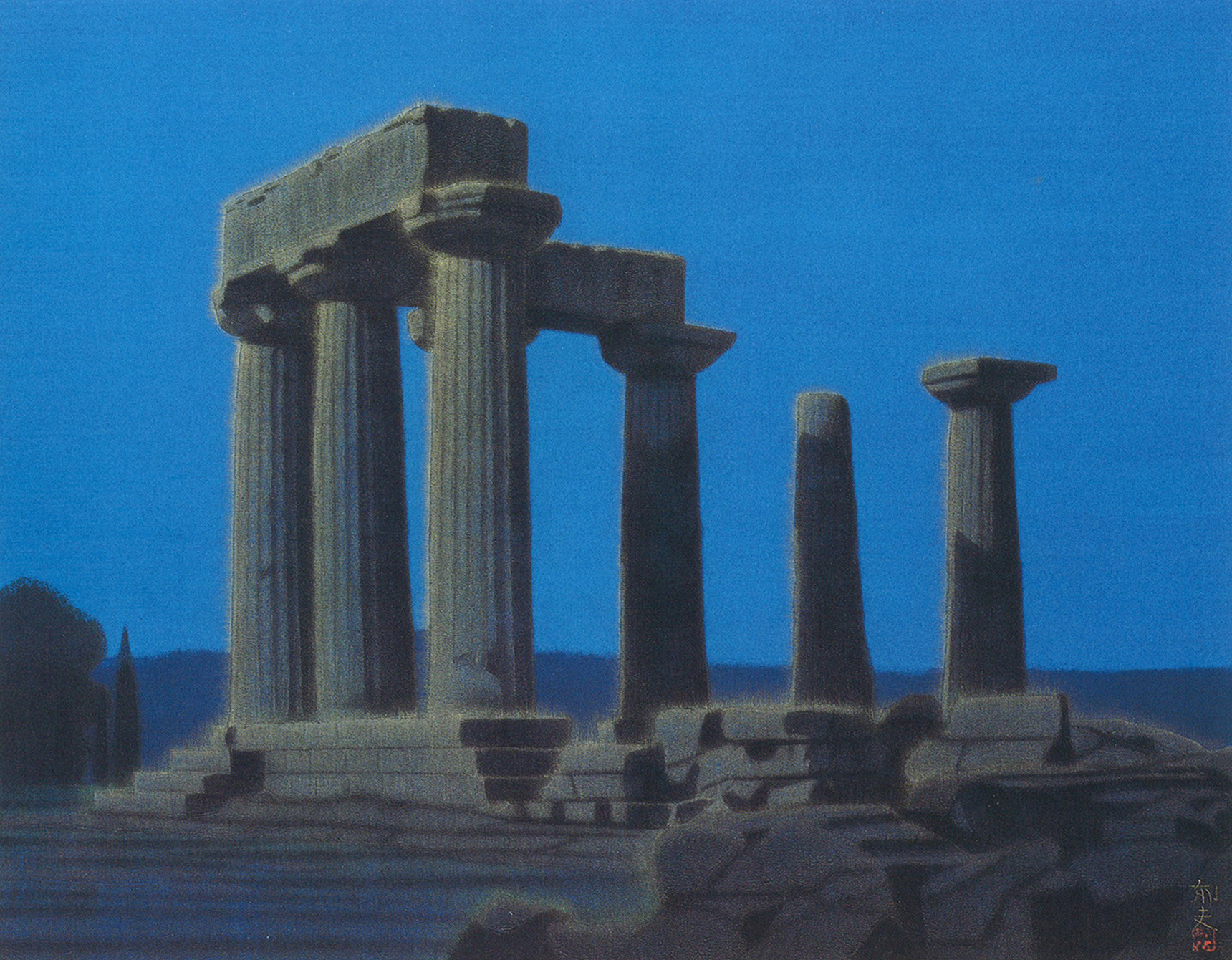
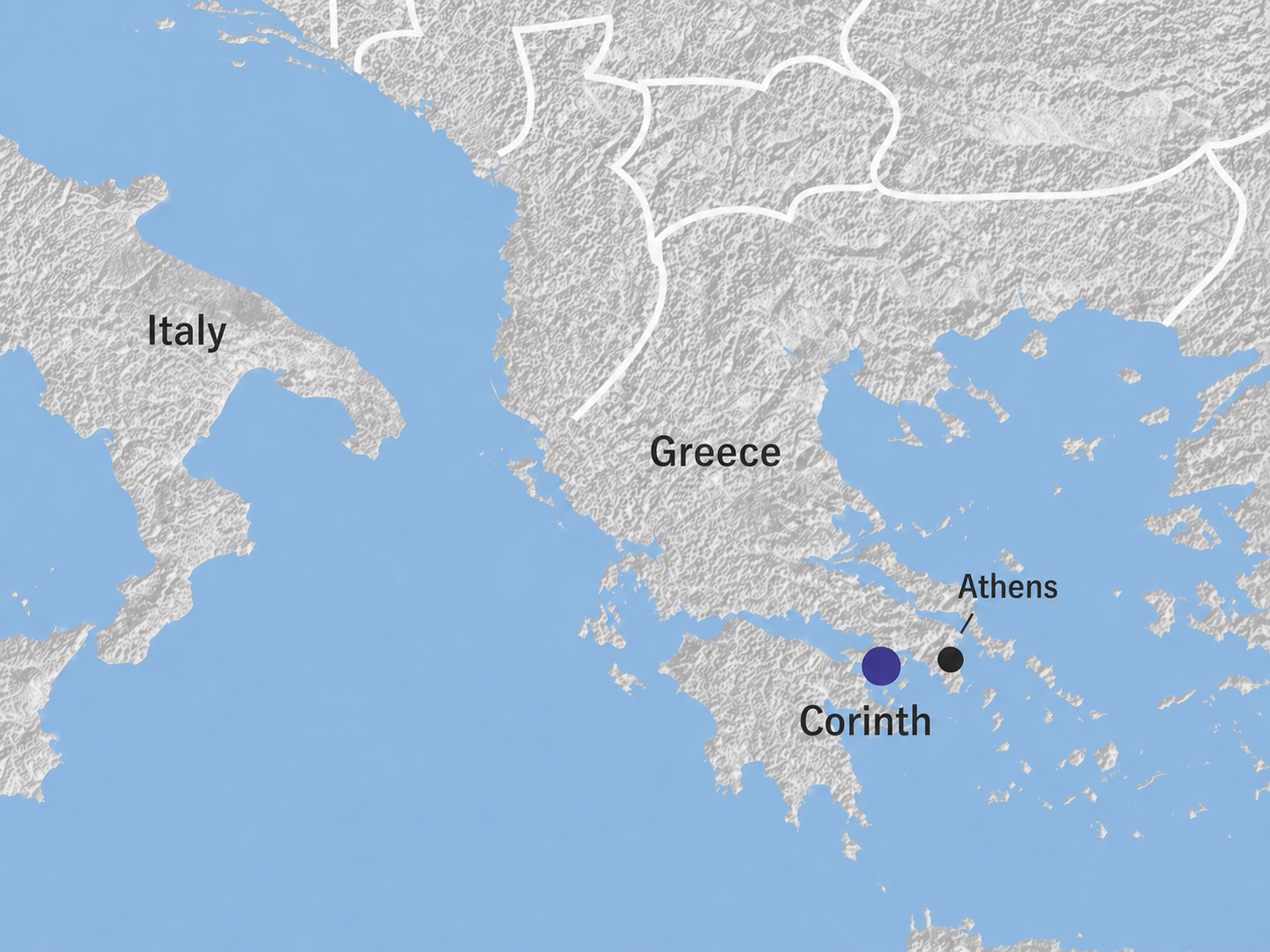
From the end of 1976 into the spring of the following year, after holding his solo exhibition Ikuo Hirayama: The SILKROAD in five Middle Eastern countries, the artist set out on a sketching journey from Damascus to Greece. He visited many ruins including Athens, Corinth, Mycenae, Delphi, Olympia, Crete, and Pella. Looking back on this trip, Hirayama said, “For me, having followed the road of Alexander, Greece was the place that brought that journey to completion.”
Corinth lies about 80 kilometers west of Athens and is a strategic transport hub linking mainland Greece and the Peloponnese. Blessed with two fine harbors on either side of the Isthmus of Corinth, it flourished from very early times as one of the most active trading cities in ancient Greece. The temple depicted in this work is the Temple of Apollo, built in the mid-6th century BCE. It is one of the oldest surviving Greek temples and a symbolic monument of Corinth. Its limestone columns, approximately seven meters high and up to 1.8 meters in diameter, are massive, and their weighty colonnade conveys the solemn atmosphere of the Archaic period.
Nine-Story Tower of the Dunhuang Caves
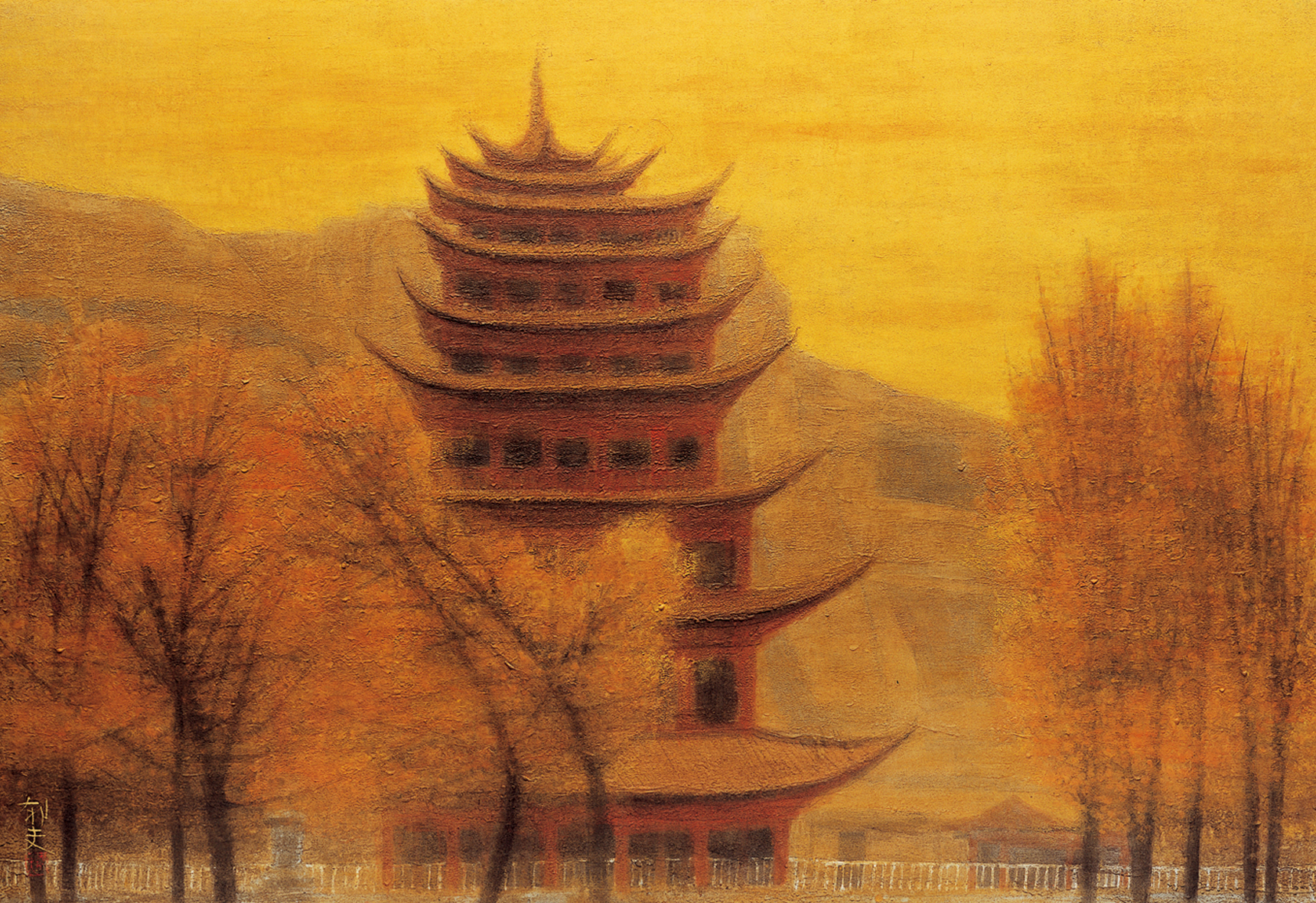
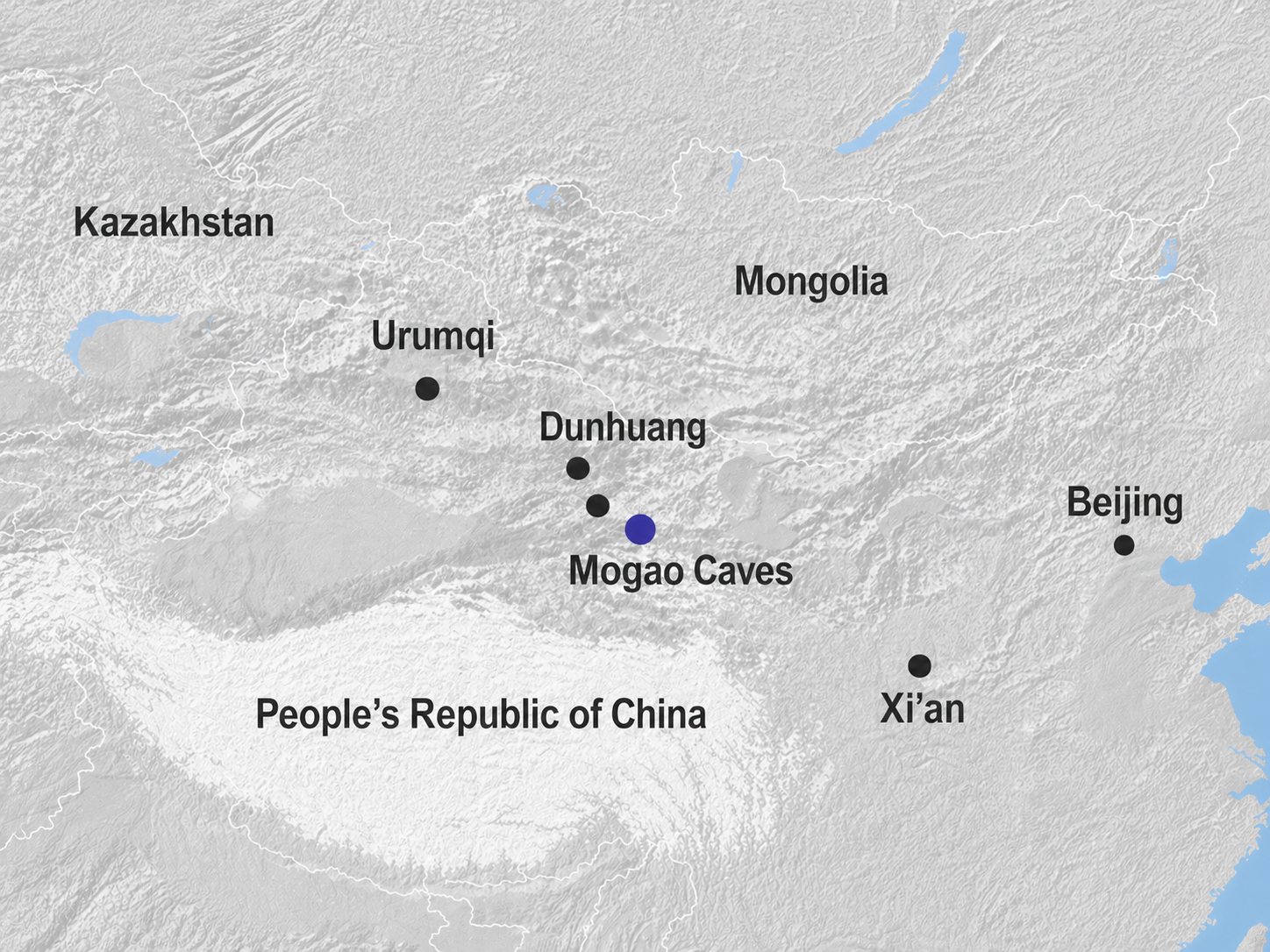
A vermilion tower rises against the orange glow of the evening sky. Dunhuang, which flourished as a city where Eastern and Western cultures met, saw the creation of 492 cave temples over a span of about 1,000 years. Founded in 695, the Nine-Story Tower, known as the Mahavira Hall (Cave 96), is a structure that may be called the symbol of the Mogao Caves of Dunhuang, housing inside a giant Buddha from the early Tang dynasty. Originally, it took the form of a four-story wooden structure attached to the front of the cave, but it was rebuilt over time and took its present form during the Republic of China period. Since his first visit to Dunhuang in 1979, the artist returned there many times, created numerous works on the theme of Dunhuang, and devoted himself to its preservation. This work depicts the Dunhuang of his very last years.
Please enjoy the works that Ikuo Hirayama continued to create throughout his life,
along with the Silk Road Collection.